
The most common household pests in Florida are roaches, ants, roof rats and mice, termites, silverfish and spiders. You can usually name each one with a one-minute look at the bug, the droppings or the damage. This guide gives the quick check for each, as we see them in Brevard County homes.
TL;DR
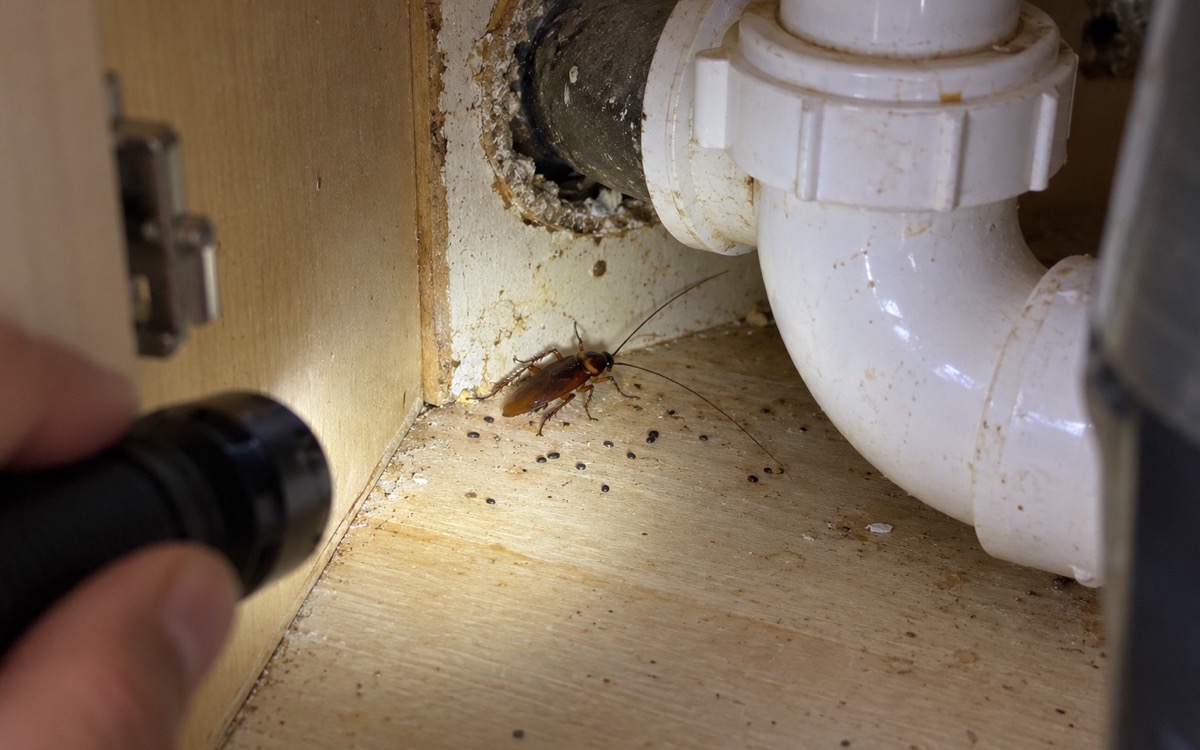
- Roaches: dark specks like ground pepper, and bugs that run when you flip on the light.
- Ants: a trail along a wall or counter. Tiny ants with pale legs are often ghost ants.
- Rats and mice: droppings, scratching at night, greasy smudges along walls.
- Termites: mud tubes outside, or tiny hard pellets under a wall or window.
- Silverfish and spiders are usually a nuisance. Termites and rodents are the two that cost real money.
Roaches and ants: the quick checks
Roaches. Look for black specks like ground pepper in cabinet corners and behind the stove. A German roach is small and tan, with two dark stripes behind the head, according to UF/IFAS Extension. Big reddish brown roaches that wander in at night are usually American roaches, the ones people here call palmetto bugs. This is the mix up that costs money. UF/IFAS says American roaches come up from sewers, or from tree limbs that touch the roof, often after heavy rain, (UF/IFAS). One in the garage is a stray. Small ones in the kitchen mean a German roach colony, and treating that like a stray lets it keep breeding. Pros check the stove first. Skip the bug bomb. An NC State study found foggers killed 10 to 38 percent of roaches, and gel baits killed 70 to 95 percent. We cover the fix in how to get rid of roaches in Florida homes.
Ants. Follow the line. Tiny ants with a dark head and pale, almost see through legs are likely ghost ants. UF/IFAS says they are only 1.3 to 1.5 mm long and nest in wall voids, cabinets and potted plants (UF/IFAS). Ghost ants have many queens and spread by budding. UF/IFAS calls a trail spray a quick fix that does not reach the queen, while baits reach the whole colony (UF/IFAS). The colony is not on your counter.
Rats and mice: how can I tell which one I have?
Check the droppings first. Mouse droppings run 1/8 to 1/4 inch. Rat droppings run 1/2 to 3/4 inch, and a rat can leave 30 to 50 a day. Roof rat droppings have pointed ends. Norway rat droppings have rounded ends (NC State, Cornell). Gnaw marks tell the same story. Cornell lists 1 to 2 mm wide for a mouse and 3.5 to 4 mm for a rat. Dark, oily smears along walls and pipes mark a route they use every night.
Then listen. The rule of thumb technicians use: rats scurry lightly and fast at night, and squirrels run early morning and late afternoon.
In Florida the rat is usually the roof rat. UF/IFAS describes it as a climber that nests in attics, roof spaces and palm trees, and says its tail is longer than its head and body together (UF/IFAS). UF/IFAS adds that they nest in soffits and wall voids. That is why the sound comes from the ceiling and not the floor.
Rat or mouse matters most when you buy a trap. Technicians say a mouse sized snap trap injures a rat or gets tripped and missed. Size also sets the gap: 1/2 inch lets in an adult rat. We cover sealing in how small a hole can a rat get through, and our rodent control page explains how we handle them.
Termites, silverfish and spiders
Termites. First, is the winged bug a termite swarmer or a flying ant? Call a swarm "just ants" and the colony keeps eating. UF/IFAS Charlotte County gives three checks: a swarmer has a thick waist, straight antennae and four wings of equal length. An ant has a pinched waist, bent antennae and unequal wings. A pile of equal length wings on a sill means swarmers came inside. UF says subterranean swarms run January to May, in daylight. Pest companies say drywood swarms run May to November, at dusk.
Drywood termites push out tiny six sided pellets that pile up like coarse sand under a wall, a window sill or a piece of trim. UF/IFAS notes these pellets can be cream, red or black (UF/IFAS). Subterranean termites build mud tubes up a foundation wall, and UF/IFAS says to look at slab joints, pipe penetrations and stucco below grade. Hollow sounding wood and swollen paint are other clues. See termite warning signs every Florida homeowner should know.
Silverfish. Silver, flat, fast and carrot shaped, with three tails at the back. They live in dark, damp spots like bathrooms and closets and chew paper and glue.
Spiders. Most house spiders are harmless and eat other bugs. If you think a spider bit you, call a doctor, not a pest company.
What we see in Brevard
Roof rats are the rat we find in Melbourne and Palm Bay attics, and they often come in from palms and fruit trees. Ghost ants and American roaches show up across the county because of the humidity. Block homes can still have drywood termites in the trim, the soffit and the attic wood. Beachside homes from Satellite Beach to Indialantic get salt air, damp and a lot of silverfish.
What to do now
- Pick the pest from the checks above and look in the one spot that fits it: kitchen corners, the attic, the sill, the wall base.
- Fix leaks and wipe up water. Pests in Florida follow moisture.
- Keep a 6 inch bare strip between mulch and the wall, and keep mulch under 2 inches deep (UF/IFAS).
- Store food and pet food in sealed containers, and keep tree limbs off the roof.
- Do not spray or fog on top of what you find. It can scatter roaches and hide the real source.
- If you find droppings, do not sweep or vacuum them. The CDC says to wet them with a 1 to 10 bleach mix first. A dust mask is not enough protection.
When to call somebody
Call if you have droppings or noise in the attic, termite pellets or mud tubes, or a roach or ant problem that returns in a week or two. Our estimate is free, and the pricing page lists our plans.
Sources
- UF/IFAS Extension: German Cockroach
- UF/IFAS Extension: Ghost Ant
- UF/IFAS Extension: Rat and Mouse Control
- UF/IFAS Extension: West Indian Drywood Termite
- UF/IFAS Extension: American Cockroach
- UF/IFAS Extension: Ants of Florida
- NC State: Bug bombs are ineffective
- NC State: Common structure invading rats
- Cornell: Mouse and rat biology and behavior
- UF/IFAS Charlotte County: Termites are in the air
- UF/IFAS: Mulch and termites
- CDC: Rodent cleanup
Frequently Asked Questions
What are the most common household pests in Florida?
Roaches, ants, roof rats and mice, termites, silverfish and spiders. Each one has a quick check, such as pepper-like specks for roaches or six sided pellets for drywood termites.
How can I tell a roof rat from a mouse?
Check the droppings and the sounds. The rat in Florida is usually the roof rat, a climber that nests in attics and palms and has a tail longer than its head and body together, according to UF/IFAS.
What are the tiny ants with pale legs in my kitchen?
They are likely ghost ants. UF/IFAS says they are only 1.3 to 1.5 mm long, have a dark head and pale legs, and nest in wall voids, cabinets and potted plants.
How do I know if I have drywood termites?
Look for tiny six sided pellets piling up under a wall, window sill or trim. UF/IFAS notes they can be cream, red or black. Hollow sounding wood and swollen paint are other clues.
When should I call a pest company?
Call if you have droppings or noise in the attic, termite pellets or mud tubes, or roaches or ants that come back in a week or two. A single bug is not an emergency, a pattern is.
Dealing with this at your place?
Gator Pest Control has served Brevard County since 1994. Free estimates, no contracts.
Get a Free Estimate Call (321) 253-1188