
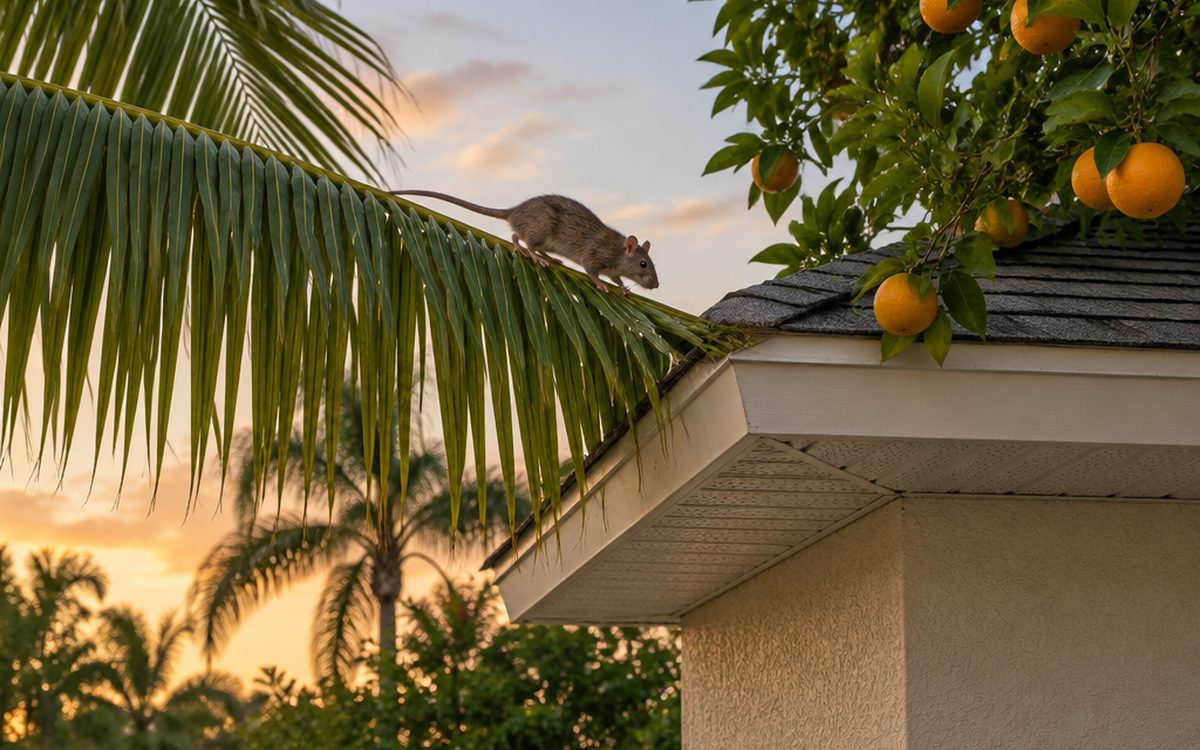
Do rats live in palm trees? Yes. The roof rat nests up high, and a palm with a thick skirt of dead fronds is one of its favorite homes. In Brevard County the real worry is what comes next: a palm close to the house gives that rat an easy road onto your roof and into the attic.
TL;DR
- The rat in your palm is almost always a roof rat. Around here people call it the palm rat or the citrus rat.
- Dead brown fronds give it cover, shade and a dry place to nest.
- A palm with fronds touching the roof or the soffit is a bridge into the house.
- Taking off the dead fronds and cutting the bridge does more than any spray.
- If you hear noise in the attic at night too, the rats have already made the jump.
Why rats live in palm trees in Florida
Roof rats are climbers. UC IPM says they usually live and nest above the ground, in trees, shrubs and thick plants. A palm suits them well. The dead fronds hang down in a tight skirt around the trunk. Inside that skirt it is shaded, dry and hard for an owl or a cat to reach.
The food is usually close by too. A lot of Space Coast yards have an orange tree, a bird feeder or pet food outside within a short walk of the palm. UC IPM says roof rats will travel 300 feet or more for food, so a palm two houses down can still be part of your problem.
The species of palm matters less than the trimming. A cabbage palm, a queen palm or a tall Washingtonia can all hold rats if the dead fronds are left on for years.
How to tell if rats are in your palm tree
You do not need a ladder to look. Most of the signs show up from the ground.
- Noise at dusk. Rustling in the fronds just after dark, when birds have settled, is a common sign. Rats are most active at night.
- Droppings at the base. Small, dark pellets with pointed ends, in the mulch or on the pavers under the palm.
- Chewed fruit. Hollowed out oranges still hanging on a nearby tree, or palm seeds that look gnawed. Our post on do citrus trees attract rats covers that one.
- A worn path. Rats run the same route every night. Look for a dark rub line on the top of a fence or a wall near the tree.
- Sounds in the attic. If the palm is near the roof and you hear scratching overhead at night, read noises in the attic at night. That usually means they have moved in.
When a palm tree becomes an attic problem
A rat in a palm out by the street is mostly a yard problem. A rat in a palm that touches your roof is a house problem.
Roof rats come in over the top of a house. They walk out a frond onto the shingles or tiles, then look for a gap. The most common one we find is where the soffit meets the fascia, at a corner of the roof. On a block home the gaps around the AC line and plumbing are the next easy door. The CDC says to seal holes inside and outside the home to keep rodents out.
UC IPM says to remove tree limbs that hang within 6 feet of a roof. That same rule fits a palm. If a frond can touch the house, or a rat can jump from it to the house, it is too close.
What we see in Brevard
The pattern is the same in Melbourne, Palm Bay and Viera. The call comes after a few bad nights of noise in the attic. Inside, there are droppings and a chewed soffit corner. Outside, there is a queen palm with three years of dead fronds lying on the roof, often next to a loaded orange tree.
The rats live in the palm, eat in the yard and sleep in the attic. Trapping the attic alone does not end it, because the palm keeps sending new ones. You have to cut the road too.
What to do now
- Look at every palm within reach of the house. If a frond touches the roof, the soffit or a screen enclosure, mark it.
- Take off the dead skirt. Remove the brown, hanging fronds. For a tall palm, hire a licensed tree service. Ask them how much green to leave, because the green fronds feed the tree.
- Cut the bridge. Keep fronds and limbs well clear of the roof. Six feet is the number UC IPM gives for trees.
- Take away the easy food. Pick up fallen fruit, bring pet food inside and empty the bird feeder at night.
- Check the roofline. Walk around the house and look at the soffit corners and the AC line holes. Our post on how small a hole a rat can get through shows what to look for.
When to call somebody
If you trimmed the palm and still hear noise in the attic at night, the rats are already inside, and a gap is still open. That is where our rodent control work starts: find the way in, seal it, then trap and clean up. The rodent inspection is free, the work is quoted after the inspection, and there is no contract.
Sources
Frequently Asked Questions
Do rats live in palm trees?
Yes. The roof rat nests up high, and a palm with a thick skirt of dead fronds is one of its favorite homes. Around here people call it the palm rat or the citrus rat.
How can I tell if rats are in my palm tree?
Listen for rustling in the fronds just after dark, look for small dark droppings with pointed ends at the base, check nearby fruit for hollowed out oranges, and look for a dark rub line on a fence or wall near the tree.
How far should palm fronds be from my roof?
UC IPM says to remove tree limbs that hang within 6 feet of a roof, and the same rule fits a palm. If a frond can touch the house, or a rat can jump from it to the house, it is too close.
Will trimming my palm tree get rid of rats in my attic?
Trimming cuts the road, but if you still hear noise in the attic at night, the rats are already inside and a gap is still open. The way in has to be found and sealed, then the rats trapped.
Dealing with this at your place?
Gator Pest Control has served Brevard County since 1994. Free estimates, no contracts.
Get a Free Estimate Call (321) 253-1188