
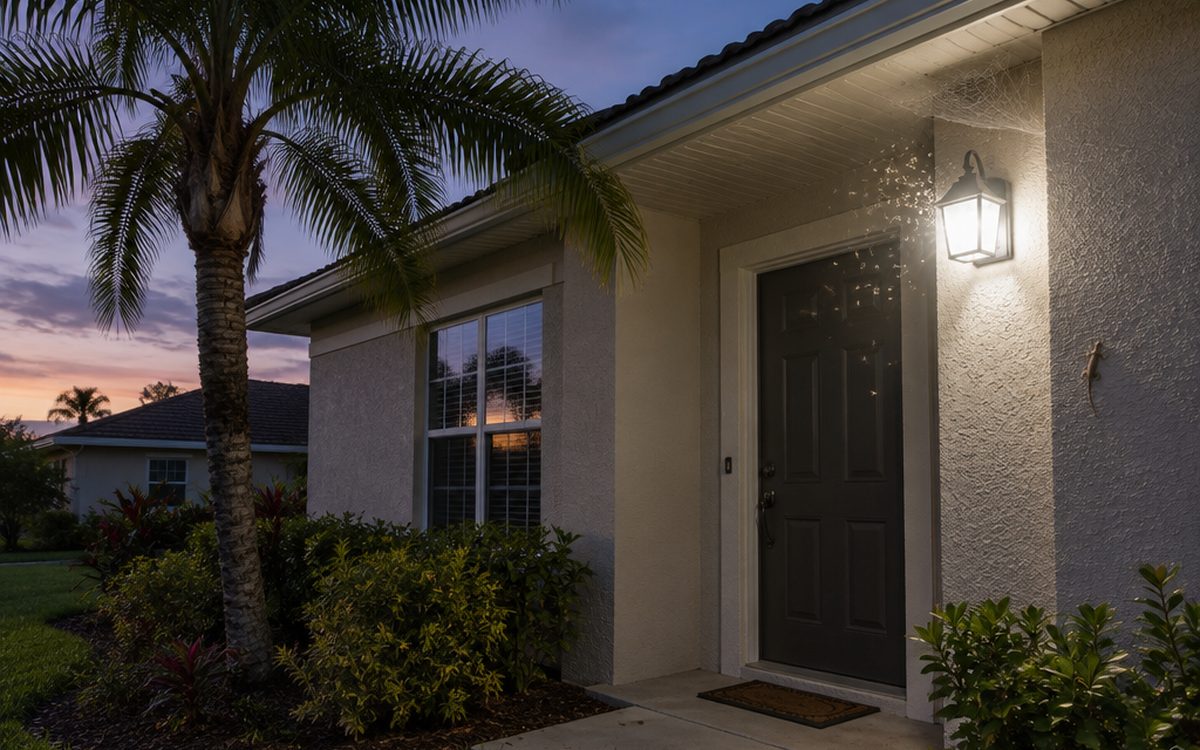
Bugs swarm around your porch light because a bright white bulb throws the kind of light night flying insects are built to steer by, and they get stuck circling it. In Brevard County that crowd sits right next to your front door. Swap to a warm or yellow LED bulb, use the light only when you need it, and close the gap under the door.
TL;DR
- Insects see ultraviolet and blue light best. Bright white and cool white bulbs pull in the most bugs.
- Warm white LEDs and yellow bug lights draw far fewer. They do not draw zero.
- The bugs are not the only visitors. Spiders, frogs and geckos come to eat them.
- A light by the door brings the bugs to the door. A worn door sweep lets some of them in.
- Bug zappers kill mostly harmless insects. Skip them.
Why bugs fly to a porch light
For a long time the common answer was that moths mistake a bulb for the moon. A 2024 study from Imperial College London, published in Nature Communications, filmed insects in flight and found a different reason. Many insects keep their back turned toward the brightest light so they know which way is up. Outside, that is the sky. At night next to a bulb, that same reflex makes them bank and circle the light instead of flying past it.
Two other things make it worse:
- Color. UF/IFAS Extension says insects see ultraviolet, blue and green light best, and that people cannot see ultraviolet at all. A bulb can look normal to you and look like a beacon to a moth.
- Heat. Old incandescent, halogen and compact fluorescent bulbs run hot. UF/IFAS notes that heat draws in insects that sense warmth.
Which porch light bulb draws fewer bugs
This is the cheapest fix in this whole post. UF/IFAS Extension recommends an LED bulb labeled warm white or ultra warm white, with a color temperature below 3600K. Look for that number on the box. Cool white, daylight and natural light LEDs sit above 3600K and draw more insects.
A yellow bug light is the other good choice. It gives off light around 550 to 600 nanometers, a range that draws far fewer insects than white light. LEDs also give off very little heat and very little ultraviolet, which is why they beat the old bulbs on both counts.
Be honest with yourself about what to expect. A yellow bulb cuts the crowd. It does not end it. And the best bulb of all is the one that is switched off. A motion sensor or a timer on the porch light helps a lot.
Skip the bug zapper. UF/IFAS advises against them because they use ultraviolet bulbs and kill many helpful insects along with the pests.
Why the porch light brings spiders, frogs and geckos
Where the bugs gather, the hunters follow. UF/IFAS Extension points out that frogs and lizards collect around outside lights to eat, and they leave droppings on the walls and the front step. Spiders build webs on and around the fixture and up under the eaves, because that is where the food flies.
None of these is a reason to panic. Most Florida spiders on a porch or a lanai are small and shy, and they eat a lot of insects. But a web filled entryway and a front door you are scared to open at night are not much fun either.
What we see in Brevard
October is a busy month for the porch light. The fall love bug flight often hangs on into this month here, as we covered in our love bug post, and the nights are still warm enough for moths, beetles and roaches to be out flying. A bright white light right by the front door collects all of it, and the spiders under the eaves grow fat on it.
The part most people miss is the door itself. The light pulls bugs to the one spot where you open and close the house all evening. If the door sweep is worn or the weather stripping has a gap, some of that crowd walks right in. That is why fixing the bulb and fixing the door go together.
What to do now
- Change the bulb. Buy a warm white LED below 3600K, or a yellow bug light.
- Turn it off when you do not need it. Add a motion sensor or a timer if you want the light for safety.
- Check the door sweep and weather stripping. If you see daylight under or around the door, replace them. It is a cheap Saturday job.
- Move the light if you can. A light mounted a few feet away from the door, shining toward it, keeps the crowd off the doorway.
- Sweep down webs around the fixture and under the eaves with a broom or a vacuum wand.
When to call somebody
If you change the bulb and still find roaches, crickets or spiders inside every morning, the light was not the whole story. Something is getting in, or something is living close by. Our general pest control service treats the outside of the house, and the Silver and Gold plans include an eaves and soffit treatment, which is where porch light spiders set up. Every plan and price is on our pricing page, and the estimate is free.
Sources
- Fabian et al., Why flying insects gather at artificial light, Nature Communications, 2024
- UF/IFAS Extension Sarasota County, Shining a Spotlight on Exterior Lighting
- UF/IFAS Extension Collier County, Spiders in the Lanai
Frequently Asked Questions
Why do bugs swarm around my porch light?
A 2024 study found that many insects keep their back turned toward the brightest light so they know which way is up. Next to a bulb at night, that reflex makes them circle the light instead of flying past it. Bright white bulbs that give off blue and ultraviolet light draw the most.
What porch light bulb attracts the fewest bugs?
UF/IFAS Extension recommends an LED labeled warm white or ultra warm white, below 3600K, or a yellow bug light. These draw far fewer insects, but not zero. The best bulb is the one that is switched off, so a motion sensor or timer helps.
Why are there spiders and geckos around my porch light?
They come to eat the bugs the light draws in. Frogs and lizards gather around outside lights, and spiders build webs on the fixture and under the eaves because that is where the food flies.
Do bug zappers help with bugs at the porch light?
No. UF/IFAS advises against them because they use ultraviolet bulbs and kill many helpful insects along with the pests.
Dealing with this at your place?
Gator Pest Control has served Brevard County since 1994. Free estimates, no contracts.
Get a Free Estimate Call (321) 253-1188