
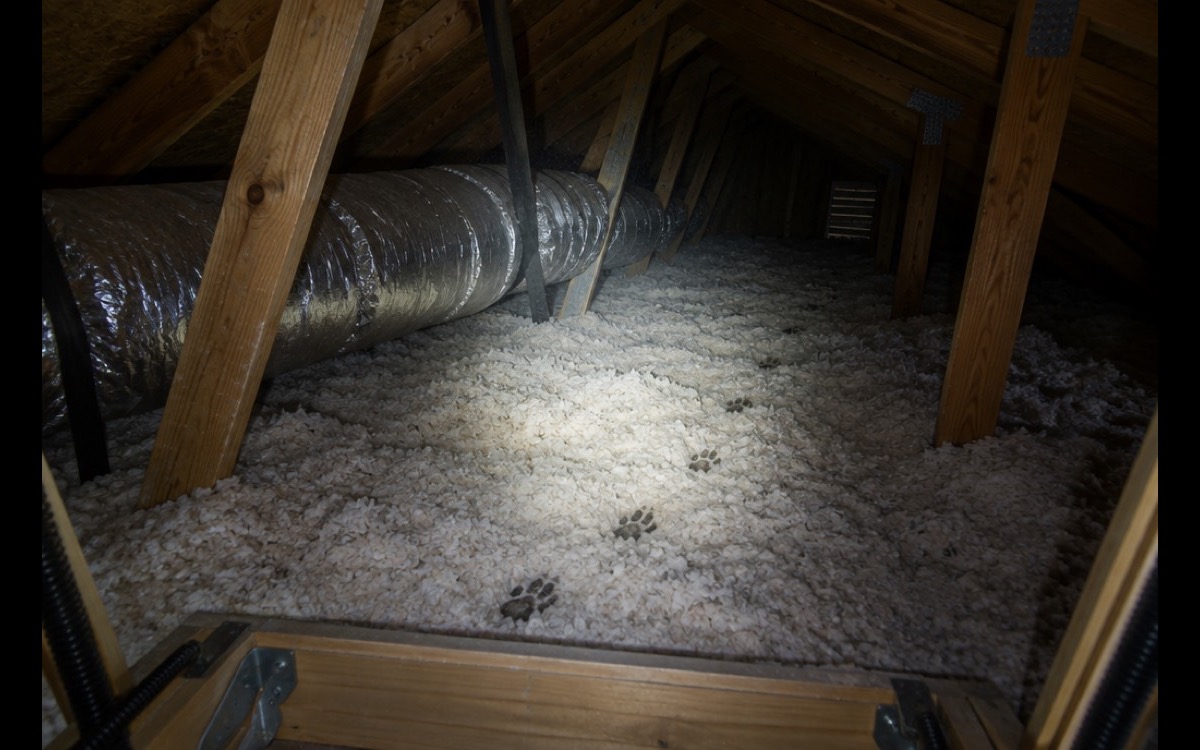
Noises in the attic at night in a Brevard County home are almost always roof rats. A rat weighs less than a can of soup, but an attic is a drum. Thin drywall, open trusses and a quiet house turn tiny feet into footsteps. If the sound starts after dark and stops near dawn, think rats. If it is loudest around sunrise and late afternoon, think squirrels.
TL;DR
- Night noise is usually roof rats. They move after sunset and nest in attics, wall voids and ceiling voids.
- Daytime noise, especially at sunrise, is usually a squirrel.
- Rats get in high: soffit gaps, gable vents, the rubber boots around roof pipes, and the hole where the AC line enters the wall.
- Trapping alone does not fix it. The gaps have to be sealed too.
Why does it sound like a person walking?
Your ceiling is a sheet of drywall screwed to the bottom of open trusses. Above it there is nothing but insulation and air. When a rat runs across a truss, a duct, or the plywood over the garage, every footfall drops straight into the room below.
One roof rat on a flat run of plywood sounds like a slow walk. Two rats fighting sounds like furniture moving. At two in the morning, when the AC cycles off and the house goes silent, all of it sounds bigger than it is. I have crawled through a lot of attics in Melbourne and Palm Bay. I have never found a person.
Noises in the attic at night: rat, squirrel, or something else?
The clock tells you most of it.
- After sunset until just before dawn. Roof rats. They are night animals. The University of California's pest program notes that roof rats nest in enclosed, elevated spaces like attics, wall voids and ceiling voids, that they are agile climbers, and that they are often seen at night running along utility lines and fence tops.
- Sunrise and late afternoon. Squirrels. The Florida Fish and Wildlife Conservation Commission says gray squirrels are active during the day and will sometimes nest in attics when they can get in. A squirrel is heavier than a rat. It sounds like a scamper, a thump, then quiet.
- A slow, heavy drag. Raccoons and opossums, through a bigger hole. We do not trap wildlife. If it sounds heavy, call a licensed wildlife trapper.
- A faint scratch, no footsteps. Mice make the same noise as rats at a smaller volume.
How they get in
Roof rats climb. The route is tree or fence to roof, then into the first gap. The CDC's list of places to check for rodent gaps starts at the top of the house: roof rafters, gables, eaves and soffits, attic vents, and the holes cut for electrical, plumbing, cable and gas lines. That matches what we find on Space Coast roofs. The soffit pulls away from the fascia as the house settles. The rubber boot around a plumbing vent cracks in the sun. A gable vent loses a slat. The AC line set goes through a hole cut too big and never sealed.
The gap does not have to be large. The CDC says a mouse fits through a hole the width of a pencil, about a quarter inch. A rat needs more, but a chewed corner on a soffit is plenty.
What we see in Brevard
The call usually comes in the morning after a bad night. I go up in the attic first and find droppings and a chewed corner of soffit. Then I walk the outside of the house, because that is where the answer always is. Nine times out of ten there is a food source close by: a bird feeder on a shepherd's hook, a loaded orange tree, or a queen palm with three years of dead fronds touching the roof. Around here the roof rat is called the citrus rat or the palm rat for a reason. It lives up high, eats fruit and seed, and crosses a neighborhood on limbs, fence tops and utility lines.
The short version of the bird feeder post is that the noise in the attic and the pile of seed shells in the yard are the same problem.
What to do now
- Note the time. Write down when the noise starts and stops for three nights. That tells you rat or squirrel before anyone climbs a ladder.
- Check the garage and the attic hatch. Look for droppings, chew marks and trails pressed into the insulation.
- Walk the outside in daylight. Look up at the soffit corners, the gable vents, the roof pipe boots, and where the AC lines enter the wall. A dark rub mark or a chewed edge is the door.
- Do not put poison in the attic. A poisoned rat dies somewhere you cannot reach, and poison also kills the owls that eat rats.
- Do not just foam the gap. Rats chew through foam. Pack the hole with steel wool or hardware cloth first, then seal it. That is the CDC method.
When to call somebody
If the noise has gone on more than a week, if you find droppings, or if you see a chewed wire, get the attic looked at. Our rat inspection is free. We check the attic, roofline, soffits, vents and garage, then give you a plain plan: seal the entry points, trap what is inside, monitor, and clean up. Trapping alone is not enough. Without the sealing, they come right back. There is no contract, and rodent work is quoted after the inspection, not on the pricing page. If it turns out to be a squirrel or anything bigger, we tell you that and point you to a licensed wildlife trapper. If there is a mess up there, read the health risks post before you touch it.
Sources
- Rats, UC Statewide Integrated Pest Management Program
- Squirrels, Florida Fish and Wildlife Conservation Commission
- How to Seal Up to Prevent Rodents, CDC
Frequently Asked Questions
What makes noises in the attic at night in Florida?
Most of the time it is roof rats. They are night animals that nest in attics, wall voids and ceiling voids and climb onto the roof along limbs, fence tops and utility lines. If the noise starts after dark and stops near dawn, think rats. If it is loudest around sunrise and late afternoon, think squirrels.
Why does a small rat sound like a person walking in the attic?
The ceiling is a sheet of drywall on open trusses with nothing above it but insulation and air. When a rat runs on a truss, a duct, or the plywood over the garage, every footfall drops into the room below and the room echoes it. In a silent house at two in the morning it all sounds bigger than it is.
How do I tell a rat from a squirrel in the attic?
By the clock. Rats move after sunset and go quiet near dawn. Gray squirrels are active during the day and sound like a scamper, a thump, then quiet. A slow, heavy drag is more likely a raccoon or opossum, which needs a licensed wildlife trapper.
Where do rats get into the attic?
High on the house. Soffit gaps where the soffit pulls away from the fascia, cracked rubber boots around roof pipes, gable vents with a missing slat, and the oversized hole where the AC line set enters the wall. The CDC says a mouse fits through a hole about a quarter inch wide, and a chewed corner on a soffit is plenty for a rat.
Should I put poison in the attic to stop the noise?
No. A poisoned rat dies somewhere you cannot reach, and poison also kills the owls that eat rats. Pack gaps with steel wool or hardware cloth and seal them, trap what is inside, and get the attic inspected. Our rat inspection is free and there is no contract.
Dealing with this at your place?
Gator Pest Control has served Brevard County since 1994. Free estimates, no contracts.
Get a Free Estimate Call (321) 253-1188