
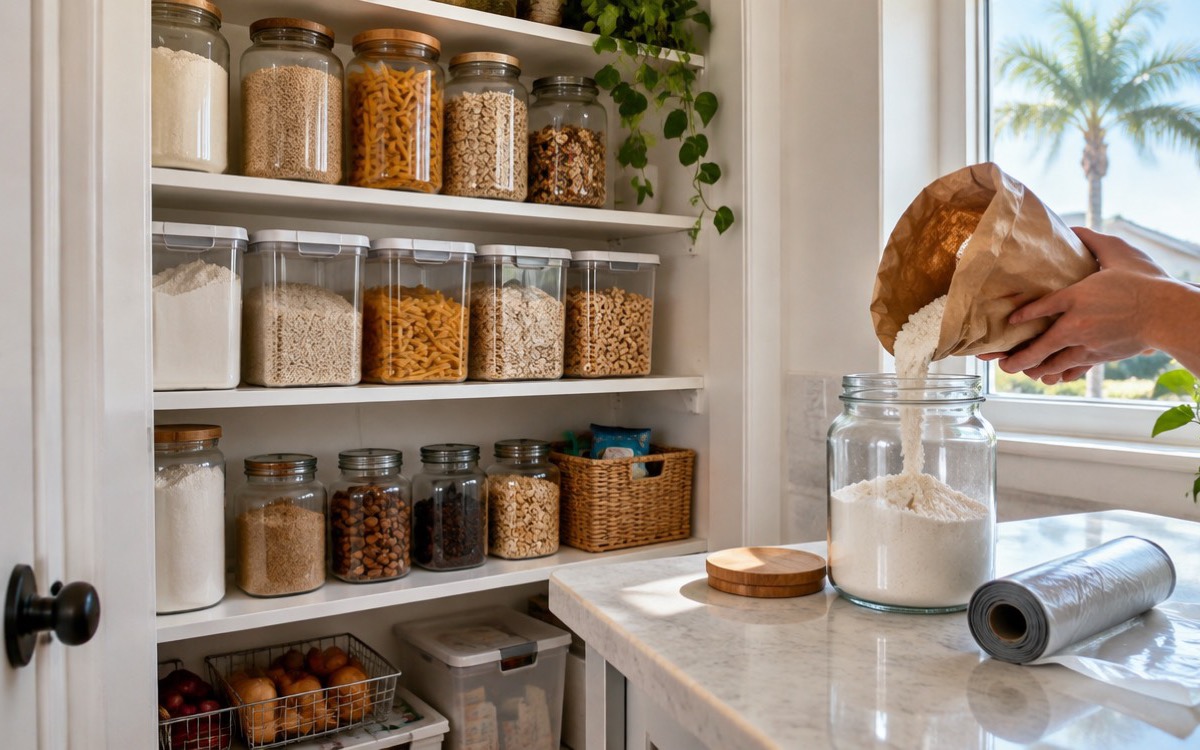
To get rid of pantry moths, find the food they are breeding in, throw it out, clean the shelves, and store dry food in sealed containers. Spraying does not fix it. In a warm Brevard County kitchen they breed fast, so the clean out has to be complete the first time.
TL;DR
- The moths you see are not the problem. The larvae in a bag of food are.
- Check every dry food, including pet food, birdseed, spices and dried fruit.
- Throw out anything with webbing, then vacuum and wipe every shelf.
- Store dry food in jars or bins with tight lids.
- Most homes fix this without a pest company.
What pantry moths are
The pantry moth most people find is the Indianmeal moth. It is small, about half an inch long. The front of each wing is pale and the back half is a copper brown. UF/IFAS Extension calls it one of the most common pests of stored food in American homes.
The adult moth does not eat. It does not bite, and it does not chew your clothes. Its job is to lay eggs. UF/IFAS says one female can lay up to 400, usually right on the food.
The larvae do the damage. They are small off white caterpillars. They feed on the surface of the food and spin silk as they go. That silk, full of droppings and shed skins, is what spoils the bag. It also shows you where they are.
How to find the source
Most of the time the moths came home in a bag from the store. Then they move to the next bag.
Look for these signs:
- Silk webbing in the food, or along the fold of a bag
- Clumps of flour or rice stuck together
- Small holes in a bag or a cardboard box
- Small off white caterpillars, often near the top of the food
- Small cocoons in corners, under shelf edges, or under jar lids
Check every dry food, not only flour and cereal. UF/IFAS lists grain products, seeds, dried fruit, dog food, spices and birdseed. Pet food and birdseed are easy to forget because they are not in the pantry.
One more thing most guides skip. Before the larvae turn into moths, they leave the food and climb. UF/IFAS says they can pupate two or more shelves up from where they fed. So a moth on the top shelf does not mean the top shelf is the problem.
How to get rid of pantry moths for good
- Take everything out. Empty the whole pantry or cabinet, not only the shelf with the moths.
- Throw out what is infested. Bag anything with webbing, larvae or holes. Tie the bag and put it in the outside trash.
- Freeze what you are not sure about. UF/IFAS says freezing a product for several days kills the larvae and eggs. Put it in a sealed bag first.
- Vacuum every surface. Get the corners, shelf edges, the shelf undersides, hinges and the cracks where crumbs collect. Empty the vacuum outside.
- Wipe it down. Soap and warm water on every shelf. Check the shelf undersides again for cocoons.
- Put food back in sealed containers. Glass jars, or plastic bins with lids that seal. Not the paper bag it came in.
Then watch for a few weeks. If moths still show up, there is a bag or a bin you missed. Look again, and look wider.
Why it is worse in a Florida house
Heat makes them breed faster. UF/IFAS says the eggs hatch in seven to eight days at 68 degrees, and in three to four days at 86 degrees. A pantry next to an oven, or a garage in August, stays warm all year here. So one bag you miss turns into a lot of moths fast.
The garage matters too. Many Brevard homes keep the big bag of dog food or birdseed out there. That bag is food for moths, and in a hot garage they do well. Our post on what attracts pests to your home has more on food left out where pests can get to it.
What we see in Brevard
Garage food storage is the same problem we see with rats. A bag of birdseed or dog food on a garage shelf feeds a lot more than the dog. Our post on bird feeders and rats covers that side of it. A sealed bin with a lid fixes both problems at once.
Pantry moths are not a sign your house is dirty. A clean kitchen gets them too, because the eggs came in with the groceries.
What to do now
- Pull every dry food out today, including the pet food and birdseed in the garage.
- Throw out anything with webbing or larvae, in a tied bag, outside.
- Freeze anything you are not sure about for several days.
- Vacuum and wipe every shelf, and look under the shelves.
- Buy enough sealed jars or bins for flour, rice, cereal, pet food and seed.
When to call somebody
Most of the time you do not need us for pantry moths. A good clean out and sealed containers fix it, and sprays do not belong on food shelves. If you are finding roaches or ants in the pantry, that is a different job, and it is part of our general pest control.
Sources
Frequently Asked Questions
How do I get rid of pantry moths?
Find the food they are breeding in and throw it out, vacuum and wipe every shelf, and store dry food in sealed containers. Spraying does not fix it.
Where do pantry moths come from?
Most of the time they come home in a bag of food from the store, then move to the next bag.
What foods do pantry moths get into besides flour?
UF/IFAS lists grain products, seeds, dried fruit, dog food, spices and birdseed. Pet food and birdseed in the garage are easy to forget.
Do pantry moths bite or eat clothes?
No. The adult moth does not eat, does not bite and does not chew clothes. The larvae in the food do the damage.
Do I need a pest control company for pantry moths?
Most of the time, no. A good clean out and sealed containers fix it, and sprays do not belong on food shelves.
Dealing with this at your place?
Gator Pest Control has served Brevard County since 1994. Free estimates, no contracts.
Get a Free Estimate Call (321) 253-1188