
No Florida law says you must have one. So do I need a termite bond in Florida? For most homes in Brevard County, yes, you should have one, because homeowners insurance usually does not pay for termite damage and subterranean termites are in the soil under almost every house here.
TL;DR
- A termite bond is a contract with a pest company. It keeps your home under termite protection over time, not just for one visit.
- No law makes you buy one, and you do not need one to sell a house.
- Homeowners insurance usually leaves termite damage out. A bond is how most people cover that gap.
- There are two main kinds. One pays to retreat. The other pays to retreat and to repair. Know which one you are signing.
- Read the contract before you sign. Florida rules say what it has to spell out.
What a termite bond is
A termite bond is an agreement tied to a termite treatment. The company treats the house, then keeps it covered for a set term, with inspections and retreatment if termites come back. You renew it to keep it in force.
It is not insurance, even though people talk about it that way. It is a service contract. What it pays for depends on the words on the page.
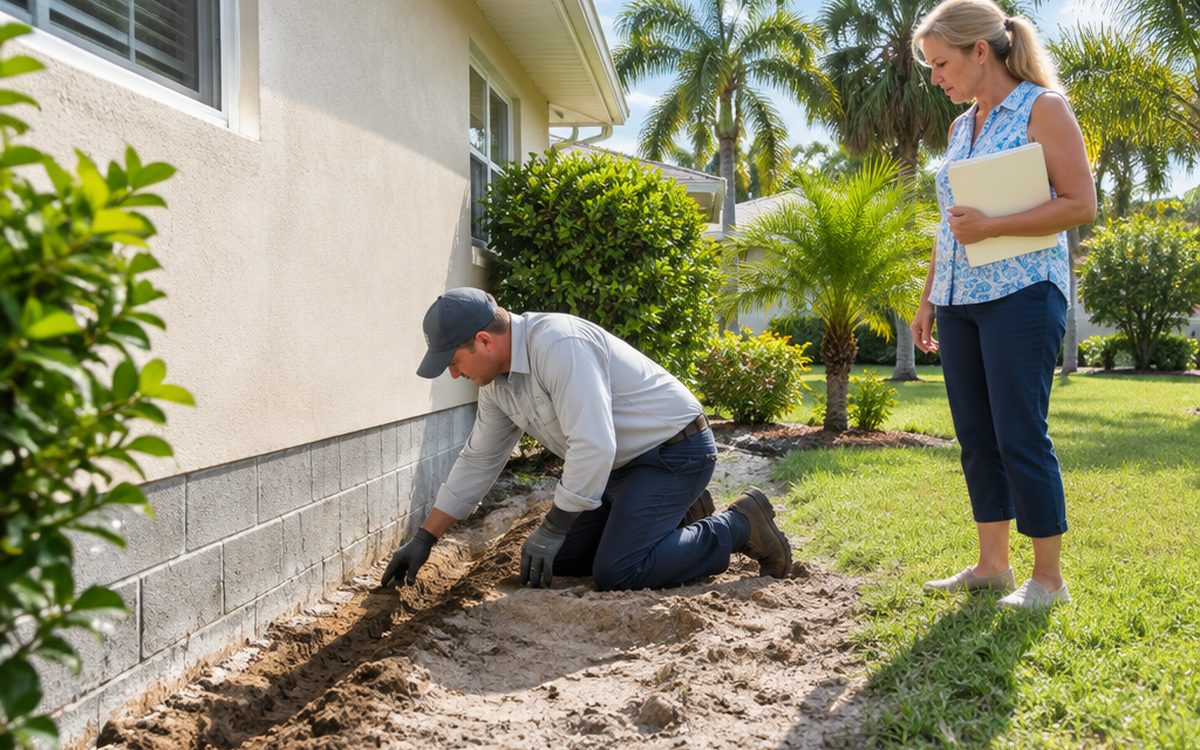
Our own termite treatment is a full trench and treat around the house, 8 to 10 inches deep, with a 10 year bond. That is one way to do it. Other companies use bait stations or partial treatment, and their bonds read differently.
Do I need a termite bond in Florida if I have never seen termites?
That is the most common question, and it is a fair one. Here is the honest answer.
Subterranean termites live in the soil and come up into the house from below, through cracks and slab edges. They work out of sight. By the time you see wings at a window or a mud tube on the block, they have often been there a while. Our post on termite warning signs covers what to look for.
Insurance is the other half. A UF/IFAS entomologist has said plainly that subterranean termite damage is left out of homeowner policies. Insurers see it as slow and preventable, not sudden like a storm. So if termites eat a wall, the bill is yours unless a contract says otherwise.
That is why waiting until you see them is not much of a plan in Florida.
The two kinds of bond, and why it matters
UF/IFAS Extension describes the common types of termite contract like this:
- Retreatment and repair. If termites come back, the company retreats and pays to fix new damage, under the terms in the contract.
- Retreatment only. If termites come back, the company retreats. Repairs are on you.
- No warranty. Spot treatments and some special cases. Nothing carries forward.
Retreatment and repair costs more, and the Florida Department of Agriculture says so too. Neither one is wrong. You just need to know which one you are paying for, so you are not surprised later.
What the contract has to tell you
Florida has a rule for termite contracts, 5E-14.105 in the state code. Among other things, a contract has to state:
- Which termites it covers: subterranean, drywood, or both. This goes on the first page.
- When the company will retreat, and when it will make repairs, if it makes any.
- The price of the treatment, any yearly renewal fee, and any repair limit, each shown on its own.
Read those parts before you sign. Then ask whether the bond transfers if you sell the house. A bond that moves to the buyer is a selling point.
What we see in Brevard
Most of our bond customers set one up because they have not had a problem yet. They are not reacting to a swarm. They looked at the cost of a repair against the cost of protection and made a plain decision.
We see a lot of this from Viera buyers and from realtor referrals, people who just bought a house and want termites off their list. Ron reads every termite request himself.
What to do now
- Find out if your house already has a bond. Look through your closing papers, or ask the seller or the builder.
- If it does, read it. Note which termites it covers, whether it repairs, and when it renews.
- If it does not, get a termite inspection before you sign anything.
- Compare bonds on the same points: treatment type, retreatment, repair, renewal fee, transfer.
- Keep every inspection report and renewal receipt in one folder.
When to call somebody
If you see wings piled on a windowsill, mud tubes on the block, or wood that sounds hollow, call a licensed company and have it looked at. If you just want to know where you stand, a termite inspection answers that. Termite work is quoted on its own, apart from the regular plans on our pricing page.
Sources
- UF/IFAS Extension Marion County, Buying Pest Services
- UF/IFAS News, UF urban entomologist on termite damage and building codes
- FDACS, Protecting Yourself and Your Property Against Subterranean Termites
- Florida Administrative Code, Rule 5E-14.105
Frequently Asked Questions
Do I need a termite bond in Florida?
No Florida law requires one, and you do not need one to sell a house. Most Brevard County homes should have one anyway, because homeowners insurance usually does not pay for termite damage.
Does homeowners insurance cover termite damage in Florida?
Usually not. Insurers see termite damage as slow and preventable, not sudden like a storm, so the bill is yours unless a contract says otherwise.
What is the difference between a retreatment bond and a repair bond?
A retreatment only bond pays to retreat if termites come back, and repairs are on you. A retreatment and repair bond also pays to fix new damage under the terms in the contract, and it costs more.
What does a Florida termite contract have to say?
Florida rule 5E-14.105 says it must state which termites it covers on the first page, when the company will retreat and make repairs, and the treatment price, any yearly renewal fee and any repair limit, each shown on its own.
Should I get a termite bond if I have never seen termites?
Subterranean termites work out of sight and come up from the soil, so by the time you see them they have often been there a while. Most of our bond customers set one up before they had a problem.
Dealing with this at your place?
Gator Pest Control has served Brevard County since 1994. Free estimates, no contracts.
Get a Free Estimate Call (321) 253-1188