
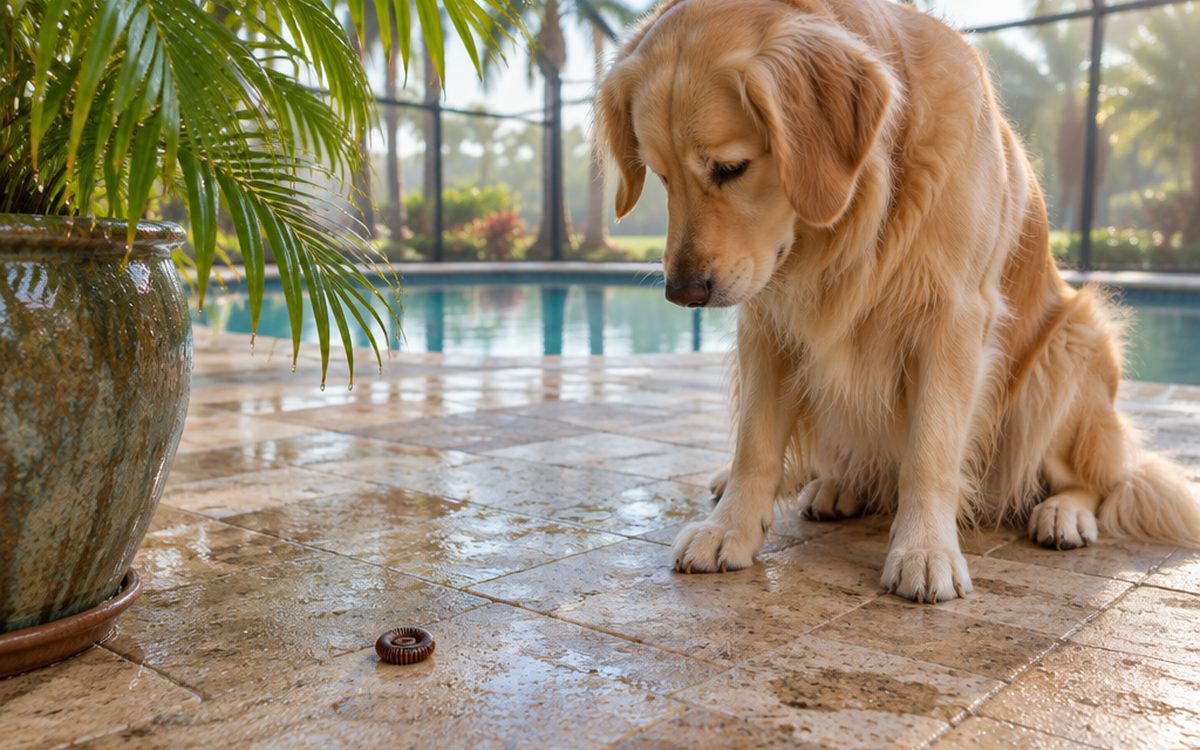
Are millipedes dangerous? No, not in any serious way. Millipedes do not bite, do not sting and do not carry disease. The one thing to know is that some kinds ooze a defensive fluid that can irritate skin and burn the eyes, so in Brevard County homes the rule is simple: do not pick them up, and keep pets from chewing on them.
TL;DR
- Millipedes have no biting jaws and no stinger. They cannot bite you.
- When they feel threatened, many curl up and give off a smelly fluid.
- That fluid can irritate skin, stain it brown for a while, and hurt badly in the eyes.
- A dog or cat that mouths one usually gets a bad taste and drools. Call your vet if it does not pass.
- Use a broom or a vacuum, not your hands.
Do millipedes bite or sting?
They do not. UF/IFAS Extension in Sarasota County points out that centipedes have biting mouthparts and millipedes do not. UC IPM, the University of California pest program, says the same thing: when disturbed, millipedes do not bite.
What they do is defend themselves with chemistry. Glands along the body give off a liquid when the millipede is grabbed, stepped on or squeezed. NC State Extension notes that millipedes can give off an unpleasant odor. UF/IFAS says some kinds put a trace of hydrogen cyanide in that fluid. It sounds scary, but it is a trace, not a dose.
If something bit you on the lanai and it was long with lots of legs, it was almost certainly a centipede. Centipedes are flat and fast, with one pair of legs per body segment. Millipedes are round, slow and curl into a coil.
Are millipedes dangerous to people and kids?
For people, the risk is the fluid, not the bug. UC IPM notes that some species give off a liquid that can irritate skin or burn the eyes. On skin it can turn the spot red, then brown or almost black. A medical case report on a millipede burn says that stain can last for several months. In the eyes it is more serious, because it can burn them.
That is why the advice from UF/IFAS is to never pick a millipede up with your bare hands. Small kids are the ones most likely to do it, since a curled up millipede looks like a toy.
If someone does handle one:
- Wash the skin with soap and water.
- Keep hands away from the eyes until they are washed.
- If the fluid gets in an eye, or the skin blisters, call a doctor or Florida Poison Control at 1-800-222-1222. Do not wait to see if it gets better.
Are millipedes dangerous to dogs and cats?
They are not a real poisoning risk for most pets, but they are not a snack either. A dog that grabs a millipede off the pool deck, or a cat that bats one around the garage, can get the fluid in its mouth or eyes. The usual result is drooling, foaming, pawing at the mouth or a few licks of the lips.
Pet Poison Helpline lists drooling as a common sign that a pet got into something it should not have. We are not vets, so here is the honest line: if your pet keeps drooling, vomits, has a red or squinting eye, or just does not act right, call your vet or Pet Poison Helpline at 855-764-7661. Tell them it was a millipede.
The bigger risk to pets is often what people use to kill millipedes. Granules and sprays thrown down on the lanai, where the dog lies, can be worse than the bugs. Our post on whether pest control is safe for pets and kids covers how we treat around animals.
What we see in Brevard
Millipedes show up in waves after fall rain, on garage floors, pool decks, lanais and along the slab, because wet mulch and soil push them out. We explained the reasons in why there are so many millipedes in your house. Those are the same places where Brevard dogs nap and kids run barefoot, which is why this question comes up every fall. Most of the millipedes that get inside dry out and die near the walls, so a pet often finds them before you do.
What to do now
- Sweep or vacuum them up. Do not pick them up by hand, and do not crush them on the tile, which spreads the fluid.
- Check the floor before the pets go out. A quick look at the lanai and the garage in the morning after a rainy night catches most of them.
- Dry out the edge of the house. Pull mulch back from the wall, fix sprinkler heads that hit the stucco, and run irrigation in the morning.
- Seal the gaps. A tight door sweep and a good garage door seal keep most of them out.
- Skip the indoor spray. Millipedes die inside on their own. Health Canada does not recommend pesticides indoors for them.
When to call somebody
For a sick pet or an eye exposure, call the vet or the doctor first, not us. If you keep sweeping up piles of millipedes for weeks, or roaches and ants are coming in the same way, a look at the moisture and the gaps around the house can help. Our general pest control covers crawling pests around the foundation, garage and lanai, and every plan is on the pricing page.
Sources
- UF/IFAS Extension Sarasota County, The Spooky Bug Brigade: Millipedes
- UC IPM, Millipede and Centipede Management Guidelines
- NC State Extension, Managing Millipedes In and Around Homes
- Case report, Millipede accident with unusual dermatological lesion
- Health Canada, Centipedes, millipedes, sowbugs and pillbugs
- Pet Poison Helpline, Signs of Poisoning in Dogs and Cats
Frequently Asked Questions
Are millipedes dangerous?
No, not in any serious way. Millipedes do not bite, do not sting and do not carry disease. Some kinds ooze a defensive fluid that can irritate skin and burn the eyes, so do not pick them up and keep pets from chewing on them.
Do millipedes bite?
No. Millipedes have no biting mouthparts and no stinger. If something long with lots of legs bit you, it was almost certainly a centipede, which is flat and fast with one pair of legs per body segment.
What happens if a dog or cat eats a millipede?
The usual result is drooling, foaming, pawing at the mouth or licking the lips from the bad tasting fluid. If your pet keeps drooling, vomits, has a red or squinting eye, or does not act right, call your vet or Pet Poison Helpline and tell them it was a millipede.
What should I do if I touch a millipede?
Wash the skin with soap and water and keep your hands away from your eyes until they are washed. If the fluid gets in an eye or the skin blisters, call a doctor or Florida Poison Control at 1-800-222-1222.
Should I spray millipedes inside the house?
No. Millipedes die inside on their own, and Health Canada does not recommend pesticides indoors for them. Sweep or vacuum them up, dry out the edge of the house and seal the gaps under doors.
Dealing with this at your place?
Gator Pest Control has served Brevard County since 1994. Free estimates, no contracts.
Get a Free Estimate Call (321) 253-1188