
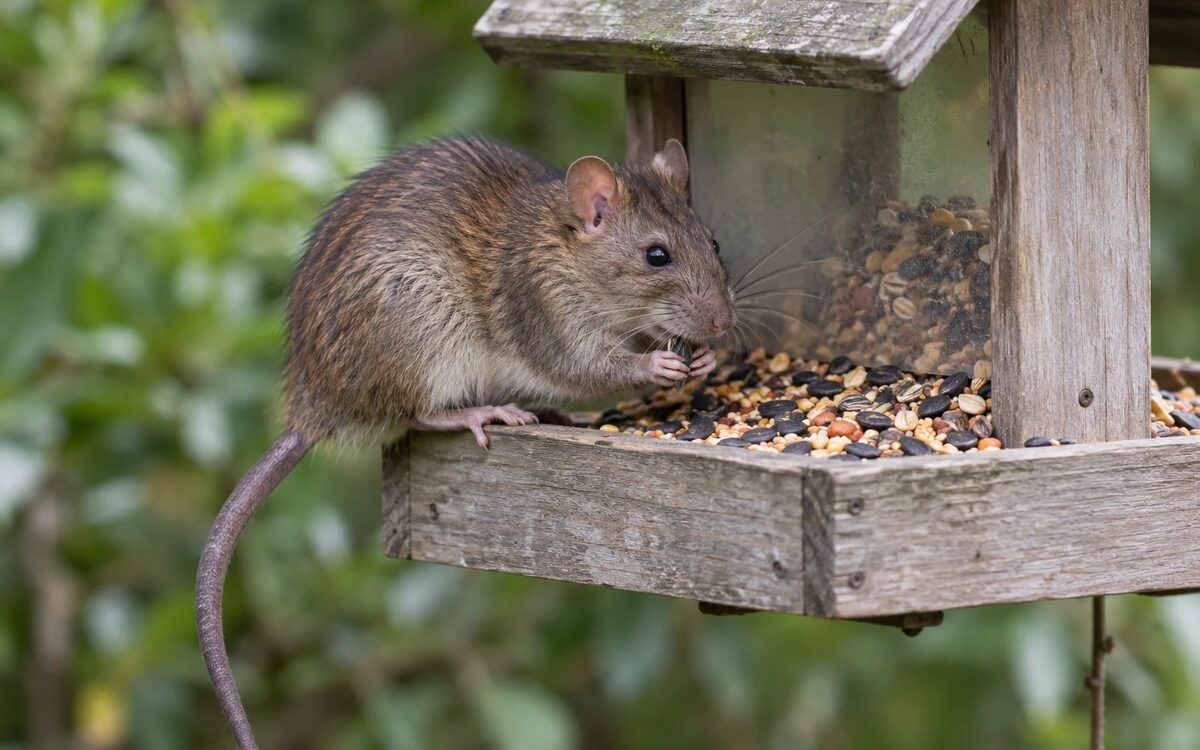
I've been putting this one off because I know how it lands. A customer calls about scratching in the attic, I walk the property, and about eighty percent of the time there it is: a bird feeder twenty feet from the house with a pile of shells underneath it. And when I point at it, the temperature in the conversation drops. People love their birds. I get it. My wife would fight me on this one too. So let me say up front that I am not telling you to take it down. I am telling you what I see, and what actually fixes it.
TL;DR
- The feeder is not really the problem. The seed on the ground under it is the problem.
- Up north the rat under the feeder is a burrower that stays low. Down here it is the roof rat, and roof rats climb.
- You do not have to choose between birds and a rodent-free attic. You have to change how you feed.
- The single highest-impact fix: bring the feeders in at dusk. Rodents feed at night. Birds do not.
- Public health guidance on placement is specific: four feet off the ground, eight feet clear of any branch, fence or object a rat can jump from.
- Please do not scatter poison bait. You will kill the owls and hawks that are already working for you for free, and you will make next year worse.
Nobody wants to hear this from the pest guy
Thirty years in Brevard and I've had this conversation a few hundred times. It usually goes the same way.
Somebody calls me out because they're hearing something in the ceiling at two in the morning. I get up in the attic, find droppings and a chewed corner of soffit, come back down, and then I walk the outside of the house because that's where the answer always is. Nine times out of ten there's a feeder hanging off a shepherd's hook or a live oak branch, and the ground under it looks like the floor of a hamster cage.
And here's the thing. That homeowner has done nothing wrong. Feeding birds is a lovely habit. A lot of my customers are retired, they're home during the day, and watching cardinals and painted buntings out the lanai is a genuine pleasure. I am not in the business of taking that away from people.
But I do have to tell you the truth about what else is showing up, usually after you've gone to bed.
Your rat is not the rat on TV
This is the part that trips people up, especially folks who moved down from the northeast.
Up north, the rat that works a bird feeder is usually the Norway rat. It's a burrower. It lives in the ground, under the shed, along the foundation, and it mostly stays low. If you keep your feeder up high you've solved a decent chunk of the problem.
That is not the animal we have.
Here it's the roof rat, Rattus rattus, and around this county you'll hear it called the citrus rat, the fruit rat, or the palm rat, which tells you everything about how it lives. It is arboreal. UF's extension folks compare it to a squirrel for its ability to move through trees and along vines and wires. It nests up high by preference: palm crowns, dense ficus, the tangle at the top of a queen palm nobody has trimmed in three years. And when it finds a gap, your attic.
So height alone buys you almost nothing. A feeder six feet up a shepherd's hook is not "out of reach." It's a destination with a ladder.
They never get a winter off
The other thing northerners don't expect is the math.
In Florida roof rats breed year round. There's no freeze to knock the population back, no seasonal reset. UF/IFAS puts a female at four to six litters a year, six to eight young in each. Run that out on a napkin and you'll see why a couple of rats in July is a real situation by Thanksgiving.
That's the part people underestimate. It isn't that you have a rat. It's that a reliable food source in the yard turns one rat into a breeding colony on a schedule that never pauses.
And if it feels like there are simply more of them lately, that isn't your imagination either. A study in Science Advances in early 2025 pulled complaint and inspection records from sixteen cities around the world and found rat numbers rising in eleven of them, with the biggest jumps in the cities that warmed the most. The mechanism the authors describe is exactly the one we live with: warmer weather stretches the active season, and even an extra week or two aboveground can mean another reproductive cycle.
Florida just skipped ahead. The winter those cities are losing is one we never had.
What is actually eating under there
Whatever you put out for the birds, the birds get maybe two thirds of it. The rest ends up on the ground as spilled seed and cracked hulls. That pile is a buffet, and it runs twenty-four hours.
In this county, the regulars are:
Roof rats. The main event, for all the reasons above. They love seed and they love fruit. If you have a feeder and an attic, you have both ends of a roof rat's ideal day.
House mice. Smaller problem, easier to miss, and they can get through a hole the size of a dime. About a quarter inch. They'll live in the mulch bed under the feeder happily until it gets wet or cold, and then they look at your soffit.
Squirrels. Everybody already knows about the squirrels. What people don't connect is that a squirrel gnawing at a feeder is also gnawing at your fascia board, and a squirrel-sized hole is a rat-sized hole.
Raccoons and opossums. They'll knock the feeder down at night and clean up the whole thing. If you're finding your feeder on the ground in the morning and blaming the wind, it probably wasn't the wind.
Ants. Especially on anything with suet or a sugar component. Ants working a seed pile fifteen feet from your kitchen will eventually find the kitchen.
Pantry pests, indoors. This one surprises people. A bag of birdseed stored in the garage is a great place for Indian meal moths and weevils to breed. Then they move into your actual pantry. I've traced more than one kitchen moth problem back to a torn seed bag on a garage shelf.
Why Brevard makes this worse
Our landscaping is practically designed for them. Mature live oaks, cabbage palms with skirts of dead fronds, thick foundation plantings, and citrus in half the backyards on the Space Coast. Roof rats nest in palm fronds. They travel on limbs, fence tops, and utility lines, which is how they cross a neighborhood without ever touching open ground.
And they do love your citrus. A roof rat will hollow out an orange while it's still hanging and leave the rind up there like a little lantern. If you've been finding those and blaming squirrels, now you know.
Add the tile and shingle roofs with soffit and fascia gaps that open up as a house settles, and you have a very short trip from the seed pile to the insulation.
The seed pile under the feeder is the part that matters. The birds are not the problem, the leftovers are.
Four feet up, eight feet out
Here's where I can give you real numbers instead of vibes.
Public Health in Seattle and King County has a fact sheet specifically about bird feeders and rats, and their placement rule is the clearest one I've seen anywhere: put the feeder four feet off the ground and eight feet out and away from any branches, fences, or other objects that rats may use to jump on to feeders.
Eight feet of clear air in every direction. That's the number that matters, and it's the one almost nobody meets.
It squares with what UF's people say about the animal itself. A roof rat can jump about three feet straight up and better than four feet across from a standing start on the ground. From a branch it isn't jumping at all, it's just walking. So UF's advice is to cut back any limb that touches or overhangs the roof, because rodents and squirrels use those limbs as a highway, and to keep plants a couple of feet off the house at their mature size, not the size they are the day you plant them.
A feeder hanging from a live oak limb that also reaches your roofline is, functionally, a feeding station installed on the rat's commute.
How to keep the birds and lose the rats
This is the part worth printing out. None of it requires giving up the hobby.
- Bring the feeders in at dusk. If you do exactly one thing on this list, do this one. Rats and mice feed at night, birds feed in the day. Take the feeder down at sunset, put it in a sealed bin in the garage, hang it back up with your coffee. You have just removed the food source for the entire window when it matters. Every other fix on this list is a distant second to this one.
- Put out only what they'll finish by dark. Same idea, less effort. If the feeder is empty at sundown there's nothing to come back for, and a route with no payoff gets dropped fast.
- Catch the spill or eliminate it. A wide seed-catching tray under the feeder collects most of the mess, and a smooth baffle on the pole stops climbers. King County recommends exactly that combination, a squirrel-proof feeder with a tray and a baffle. If you want to end the argument completely, there are weight-triggered feeders that close up under anything heavier than a chickadee.
- Stop buying the cheap mix. Those bargain bags are padded out with millet, milo and cracked corn that most Florida songbirds won't touch. The birds kick it straight onto the ground looking for the sunflower, and you have effectively bought a bag of rat food with a few sunflower seeds mixed in. Better: sunflower hearts, which leave no hulls at all, or safflower, which squirrels and grackles tend to leave alone, or nyjer, the fine black thistle seed the goldfinches love and rodents largely ignore. Fair warning from the bird people, hulled seed spoils faster and has to be kept dry, so buy smaller bags.
- Rake underneath, weekly. Not "when it looks bad." Weekly. Rake up the hulls and dropped seed and bag it. Cornell's Project FeederWatch recommends the same thing, partly for rodents and partly because moldy hulls make the birds sick too. Here's a trick that makes it painless: set the feeder over pavers or a patio stone instead of grass. Cleanup goes from a chore to two minutes with a broom.
- Store the seed in metal. Galvanized can with a tight lid. Not the paper bag it came in, and not a thin plastic tote either, because a rat will chew through a tote without slowing down. Metal, lid on, and ideally not in the garage if the garage shares a wall with the house.
- Clean the feeder itself. Every week or two, more often when it's been wet, which around here is most of the summer. Scrub it and let it dry fully before refilling. This is mostly a bird health issue, but a crusted feeder also holds odor, and odor is advertising.
- Deal with the rest of the yard while you're at it. Pick up fallen citrus. Trim the dead fronds off the palms. Pull the mulch back from the foundation. Move the woodpile off the wall. The feeder gets blamed for a lot of problems that are really a whole-yard problem, and fixing only the feeder while leaving a loaded orange tree twelve feet away won't get you there.
Please don't scatter poison out there
I want to spend a minute on this because it's the most common mistake I see after the feeder itself, and it's the one that does damage well past your property line.
Somebody figures out they have rats, drives to the hardware store, and puts out bait blocks. It feels like decisive action. Here's what actually happens.
The poison does not stay in the rat. A rat that eats an anticoagulant bait doesn't drop on the spot, it wanders around dying for several days, slow and easy to catch, and it keeps that poison in its body the whole time. Then a barn owl takes it. Or a red-shouldered hawk, or a fox, or your neighbor's cat. That's called secondary poisoning, and it is not a rare freak occurrence. Extension researchers in New Hampshire reported necropsies where thirty-four of thirty-five wild animals tested had rodenticide in them. Thirty-four out of thirty-five.
Think about what that costs you locally. A single barn owl family eats a serious number of rodents in a season. Those birds are the best rat control in Brevard County and they work for free. Poisoning your rats poisons the predators eating your rats, and once they're gone the population comes back into an empty niche with nothing hunting it. You have made next year worse, and you have killed an owl to do it.
The alternative is not complicated and it's what we do anyway: cut off the food, seal the entry points, and trap what's already inside. Snap traps set along walls, not out in the open, because rodents run the edges of a room and almost never cross open ground if they can help it. It's slower than dumping bait in the attic and it actually holds.
If you have dogs or small kids, there's a second reason. An anticoagulant bait is just as dangerous to a curious dog as it is to the rat.
If you've already got activity, pull them down for a while
Different situation. If you are already hearing things in the ceiling, or you've found droppings, the advice changes.
Take the feeders down completely for a few weeks. Not because the feeder caused everything, but because while we're trapping and sealing, I need the yard to be as unappealing as possible. A rat that has a reliable food source thirty feet from the entry point we just closed will spend real effort finding a new way in. A rat with nothing to eat moves on. This is standard guidance from the wildlife people too, not just something I invented to make my job easier.
Once the attic is clean, the entry points are sealed, and we've had a quiet couple of weeks, put the feeders back up using the list above. I've had plenty of customers keep feeding birds for years after a rodent job with zero repeat problems. It's entirely doable. It just isn't doable with a feeder hanging off the soffit and a seed pile underneath.
How to tell it has already moved indoors
Signs it's gone past the yard:
- Scratching, scurrying or thumping in the ceiling or walls, usually right after dark and again before dawn
- Droppings in the garage, along baseboards, on top of the water heater, or in the attic insulation
- A sharp ammonia smell in the attic or in a closet that backs onto an exterior wall
- Insulation that looks flattened, tunneled or pushed aside
- Chewed corners on soffit, fascia, or the rubber boots around roof penetrations
- Grease marks, which look like dark smudges along a wall or a rafter where they run the same route every night
- Hollowed-out citrus still hanging on the tree
- The dog or cat suddenly very interested in one spot on the ceiling
Any of those and it's past the point where changing your seed is going to fix it.
We'll come look at it for free
If you're hearing something up there, or you've got a feeder and you'd rather get ahead of this, we'll come out and inspect it. No charge, no obligation. I'll walk the property with you, show you what I'm seeing, and tell you straight whether you have a problem or just a messy yard.
Free estimate. No obligation. Brevard County's local rodent guys.
Bottom line
I'm not the guy who tells you to take the feeder down and stop enjoying your yard. That's a lousy trade and most people won't do it anyway, they'll just stop calling me.
What I'll tell you is that a bird feeder is a food source that stays out all night, and the animals that show up after dark are not the ones you hung it for. Bring it in at sunset. Catch what falls. Four feet up and eight feet clear of anything they can jump from. Rake underneath. Store the seed in metal. And leave the poison on the shelf.
Do that and you can have the cardinals and a quiet attic both. I've seen it work on plenty of houses in this county.
And if it's already past that, you know where to find us.
Ron
Sources
- Public Health, Seattle and King County, "Bird Feeders and Rats: What You Need to Know." Source of the four feet up, eight feet out placement rule and the tray-and-baffle recommendation. kingcounty.gov
- Kern, W. H., "Control of Roof Rats in Fruit Trees," SSWEC120, UF/IFAS Extension Cooperative Urban Wildlife Program. Roof rat breeding rate, climbing, palm nesting and citrus damage. edis.ifas.ufl.edu
- Davis, Oi, Sanderson, Moffis and Lester, "Landscaping Methods to Prevent Pests from Entering Your Home," IN1397, UF/IFAS Extension. Roof rat jumping distances, overhanging limbs, plant clearance and bird feeder placement. ask.ifas.ufl.edu
- Koehler, P. G. and Kern, W. H. Jr., "Rat and Mouse Control," ENY-224, UF/IFAS Department of Entomology and Nematology. edis.ifas.ufl.edu
- Richardson, J. L. et al., "Increasing rat numbers in cities are linked to climate warming, urbanization, and human population," Science Advances, January 31, 2025. pubmed.ncbi.nlm.nih.gov
- University of Richmond, "New Study Shows Increases in Rat Populations Around the Globe are Linked with Warming Temperatures and Growth of Cities," 2025. news.richmond.edu
- Brown, Vicki J., "Wildlife-Safe Alternatives to Harmful Rodent Poisons," University of New Hampshire Extension, May 27, 2025. Secondary poisoning of owls, hawks, fisher and fox, and the necropsy figure cited above. extension.unh.edu
- Project FeederWatch, Cornell Lab of Ornithology, "Feeding Birds." Hulled seed, raking beneath feeders, cleaning frequency, and scattered bird food attracting rodents. feederwatch.org
- Cornell Lab of Ornithology, All About Birds, "How to Clean Your Bird Feeder." allaboutbirds.org
- National Audubon Society, "Three Easy but Important Ways to Keep Your Bird Feeders Disease-Free." audubon.org
Frequently Asked Questions
Do bird feeders really attract rats in Florida?
The feeder itself is not the draw, the spilled seed and cracked hulls on the ground underneath it are. In Brevard the animal that shows up is usually the roof rat, also called the citrus or palm rat, which breeds year round here and climbs well enough to reach a feeder easily.
How far should a bird feeder be from the house and trees?
Public health guidance is to place feeders four feet off the ground and eight feet out and away from any branches, fences, or other objects a rat could jump from. Height on its own is not enough, because roof rats are climbers and will simply walk out along a limb.
What bird seed is least likely to attract rodents?
Sunflower hearts leave no hulls on the ground, safflower is one squirrels and grackles tend to leave alone, and nyjer thistle is largely ignored by rodents. Avoid cheap blends heavy in millet, milo and cracked corn, because the filler birds kick aside is exactly what feeds rats.
What is the single most effective thing to do about it?
Bring the feeders in at sunset. Rats and mice feed at night and birds feed during the day, so taking the feeder down at dusk removes the food source for the entire window when it actually matters.
Should I put out rat poison if I already have rats?
No. Anticoagulant bait does not stay in the rat. A poisoned rat stays alive for days and is easily caught by owls, hawks, foxes and cats, which are then poisoned in turn, and the same bait is just as dangerous to a dog. Cutting off the food, sealing entry points and trapping is slower but it holds, and it does not kill the predators already controlling rats for you.
Dealing with this at your place?
Gator Pest Control has served Brevard County since 1994. Free estimates, no contracts.
Get a Free Estimate Call (321) 253-1188