
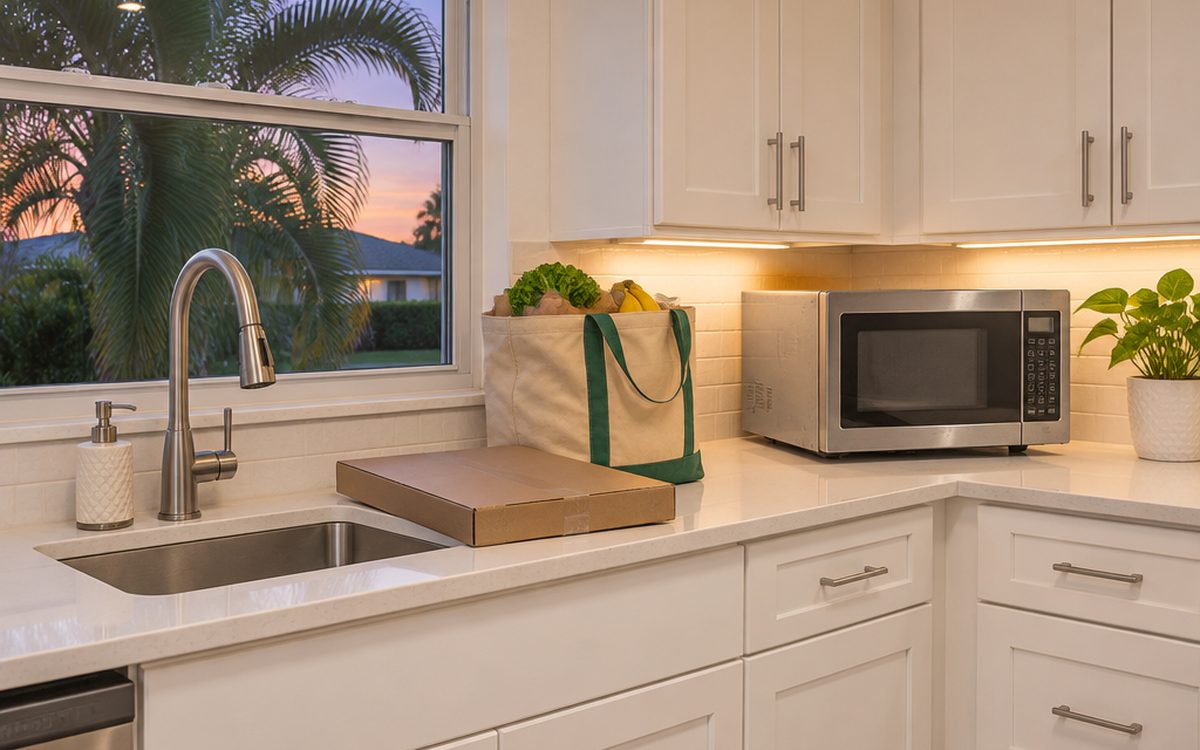
If you have German roaches in a clean house, it does not mean you are a bad housekeeper. German roaches do not walk in from the yard. They get carried in, on a cardboard box, a grocery bag, a used appliance, or through a shared wall. Once a few are inside, a clean Brevard County kitchen still gives them all they need: a drop of water, a crumb, and a warm crack to hide in.
TL;DR
- German roaches live only indoors. They arrive with things you bring home or from a unit next door.
- Clean helps, but it cannot stop them. They need very little food, and water is easy to find.
- One female can carry an egg case of about 40 eggs, so a few roaches turn into a colony fast.
- Sprays and bombs make it worse. Gel bait and a plan over several visits work.
How do German roaches get into a clean house?
The German roach is the small tan one, about half an inch long, with two dark stripes behind its head. UF/IFAS says it cannot survive away from people. It does not come in from the mulch like a palmetto bug. Somebody carries it in.
The usual rides:
- Cardboard boxes. Deliveries, moving boxes, and boxes from a storage unit. Roaches hide in the folds and the glue.
- Grocery bags and drink cases from a store with its own roach problem.
- Used appliances and furniture. A secondhand fridge, microwave, toaster oven or coffee maker can hold egg cases deep inside where the motor stays warm.
- Shared walls. In a condo, duplex or apartment, they move between units along pipes and wiring. Rutgers Extension notes this is why the German roach is so common in apartment buildings.
None of that has anything to do with how clean you keep the house.
Why a clean kitchen is not enough
Clean matters. It just cannot do the whole job. A German roach needs very little. Rutgers Extension lists what they eat: human food, pet food, fruit, even leather and the glue in book bindings. A few crumbs under the toaster or a film of grease on the stove hood keeps a small group alive.
Water is the real draw. The drip under the sink, the wet sponge, the condensation around the fridge and the dishwasher. Rutgers says the most roaches gather around the stove and the refrigerator, where it is warm and dark.
Then the numbers take over. A female carries an egg case with about 40 eggs and makes five to eight of them in her life. The full life cycle takes about 100 days. So a few roaches that rode in on one box can be a real problem within a few months, in a spotless house.
Why spraying does not end German roaches in a clean house
Most people lose months here: they spray, get a quiet week, and then the roaches come back.
Store sprays are weak against German roaches. Rutgers Extension says they work worse than bait because roaches have built up resistance and learn to avoid the treated spots. Store foggers are worse still. Rutgers calls them ineffective, and they can be a fire risk in a home with a gas stove. We see foggers push roaches deeper into the walls.
What works is bait, put close to where they hide, and a follow up. Ron's point on German roaches is that the products have to be rotated in a set order, timed to the roach life cycle, because they build resistance to anything used over and over. That is why one visit does not end it. It takes a plan over several visits.
What we see in Brevard
In the kitchen, the small tan roach is the one that comes in with groceries, boxes and used appliances. Snowbird homes and rentals that sit closed up with a dripping tap can have a quiet German roach population by the time the owner comes back in the fall.
A condo building is a much bigger job than a house. With shared walls and many kitchens, treating one unit while the unit next door stays infested only holds for so long. If you live in a condo in Melbourne, Satellite Beach or Cocoa Beach, ask your neighbors and your building manager what they are seeing. We wrote more about that in my neighbor had pest control, now I have bugs.
What to do now
- Check what you have. Small and tan with two stripes is a German roach. Big and reddish brown is a different roach. Our roach guide shows how to tell them apart.
- Look with a flashlight at night: behind the fridge, under the sink, around the stove, and in the cabinet hinges. Black specks like pepper and small brown egg cases mean they live there.
- Break down cardboard boxes and get them out of the house the day they arrive. Do not store them in the kitchen or the garage.
- Fix the drip under the sink, wring out the sponge, and take up pet food and water bowls at night.
- Skip the spray can and the bomb. They scatter roaches deeper into the walls.
When to call somebody
If you see small tan roaches more than once, in daylight, or in more than one room, there is a colony, and store products rarely reach it. A German roach job takes an inspection and a few planned visits, not one spray. Our general pest control service covers roaches across Brevard County.
Sources
Frequently Asked Questions
Why do I have German roaches in a clean house?
German roaches do not walk in from the yard. They get carried in, on a cardboard box, a grocery bag, a used appliance, or through a shared wall. Once a few are inside, a clean kitchen still gives them a drop of water, a crumb, and a warm crack to hide in.
How do German roaches get into a house?
The usual rides are cardboard boxes, grocery bags and drink cases, used appliances and furniture, and shared walls. In a condo, duplex or apartment they move between units along pipes and wiring.
Do roach sprays and bombs work on German roaches?
Not well. Rutgers Extension says store sprays work worse than bait because roaches have built up resistance and avoid treated spots, and it calls foggers ineffective. Bait placed close to where they hide, with a follow up, is what works.
Why does it take more than one visit to get rid of German roaches?
German roaches build resistance to anything used over and over, so the products have to be rotated in a set order, timed to the roach life cycle. That takes a plan over several visits, not one spray.
Dealing with this at your place?
Gator Pest Control has served Brevard County since 1994. Free estimates, no contracts.
Get a Free Estimate Call (321) 253-1188