
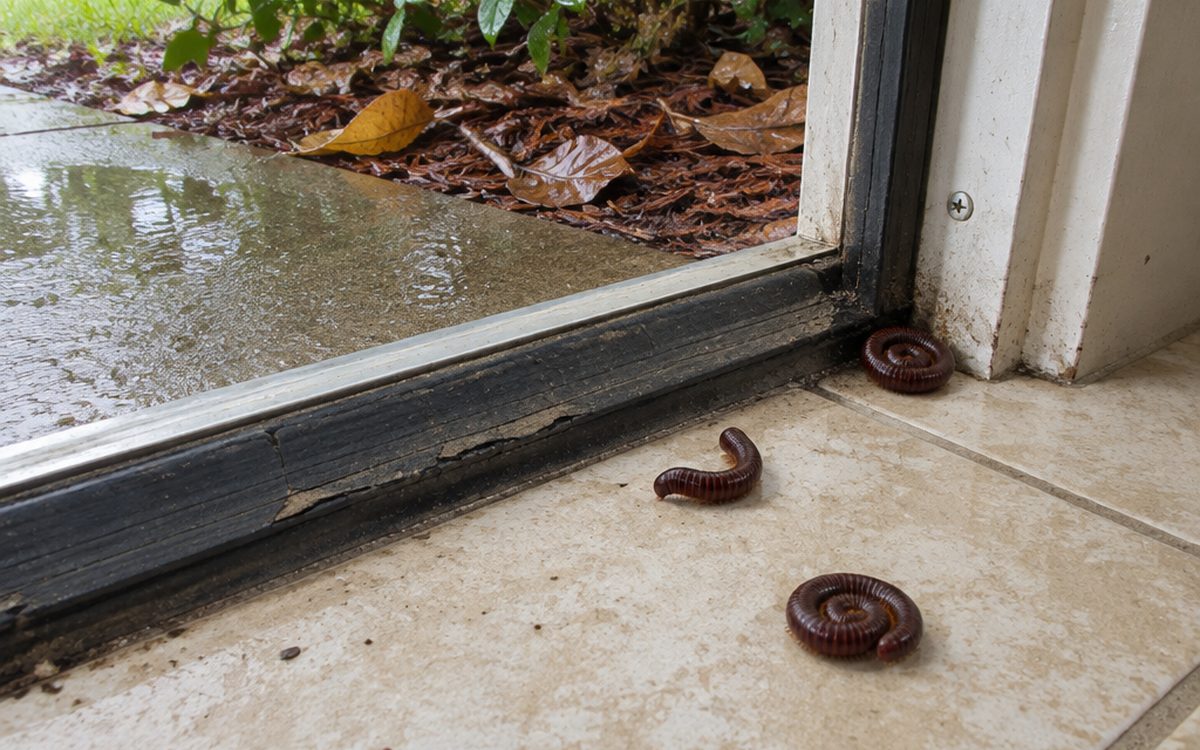
If there are so many millipedes in your house, the soil outside got too wet. Heavy rain or a lot of irrigation fills the mulch and topsoil with water, so millipedes climb out and walk to the nearest dry ground, which is often your slab. In Brevard County that happens most after a rainy stretch in the fall, and the fix starts outside, not with a spray can.
TL;DR
- Millipedes live in damp mulch, leaf litter and topsoil. Too much water pushes them out.
- They do not bite, sting, spread disease or damage the house.
- Most die inside within a short time because the air is too dry for them.
- Sweep them up or vacuum them. Spraying inside does very little.
- Dry out the strip next to the house and seal the gaps under doors.
What are millipedes, and why are they here?
Millipedes are slow, worm shaped crawlers, brown to black, with two pairs of legs on each body segment. Most have somewhere between 40 and 400 legs, not a thousand. When you touch one, it curls into a tight coil.
Outside, they do useful work. They eat dead leaves, rotting wood and fallen fruit, and turn it back into soil. That is why they live in compost, mulch beds and the leaf litter under shrubs.
The trouble starts when that home floods. UF/IFAS Extension explains that excess rain or irrigation fills the air spaces in the soil, so millipedes leave and look for drier ground. A house slab is dry, flat and right next to the mulch. Some come in through the gap under a door, and some just end up on the lanai or the garage floor. Very dry weather can move them too, as they go looking for damp.
In Florida you will mostly see three kinds: the bumblebee millipede and the rusty millipede, which both came here from somewhere else, and the native Florida ivory millipede.
Why are there so many millipedes in my house this time of year?
Millipedes move in large groups. When the ground stays wet for days, a whole bed of them leaves at once, and that is when people see dozens in a morning. Fall rain in Brevard, plus sprinklers that still run on a summer schedule, keeps the beds next to the house soaked.
Light plays a part as well. Millipedes are active at night, and a lot of them wander toward light fixtures. UF/IFAS Charlotte County notes that the ones that get inside often die near lights because they cannot handle dry air for long. That is why you find them curled up and dead along the baseboard, by the garage door, or under the porch light.
They cannot set up a colony inside a dry, air conditioned house. So a house full of millipedes is really a yard full of millipedes, and the yard is where you fix it.
Are millipedes in the house a problem?
Mostly, no. They do not bite or sting, they do not carry disease, and they do not eat wood, food or clothing. They are a nuisance, not a danger.
One thing to know: some millipedes give off a fluid when they are handled, and it can irritate skin. Use a broom and dustpan, a vacuum, or a paper towel instead of your bare hands.
Do not confuse them with centipedes. A centipede is flat, fast, and has one pair of legs per segment. It hunts other bugs and it can bite. A millipede is round, slow and curls up.
What we see in Brevard
A lot of Brevard homes are block and slab, with a mulch bed or rock bed right up against the wall and sprinkler heads aimed at it. We wrote about that setup in our post on whether mulch attracts bugs. Wet mulch touching the stucco is the perfect millipede bed, and the slab is the first dry spot they reach.
The other common setup is the lanai and the screened pool cage, where millipedes crawl in at the bottom of the screen and gather on the deck. Garages are a close second, because the rubber seal at the bottom of the door is often worn or torn.
What to do now
- Sweep or vacuum them up. Put live ones back outside, or bag them and throw them out. Do not spray them indoors.
- Cut back the water. Set sprinklers to run in the early morning, not at night, and check that no head sprays the house wall. Point downspouts away from the slab.
- Pull the mulch back. Leave a strip of a few inches of bare ground or gravel against the wall, and rake out leaf litter under shrubs.
- Seal the door gaps. A new door sweep and a good garage door seal stop most of them. Our post on door sweeps shows what to look for.
- Wait out the wet week. Most millipede waves end when the ground dries.
When to call somebody
If you have fixed the mulch and the water and you still sweep up dozens every day for a couple of weeks, or you are seeing roaches, earwigs or ants come in the same way, it is worth a look. UF/IFAS notes that a perimeter treatment outside only gives temporary relief, so a good visit should start with where the water and the gaps are. Our general pest control covers crawling pests at the foundation, garage and lanai, and every plan is on the pricing page.
Sources
- UF/IFAS Extension Sarasota County, The Spooky Bug Brigade: Millipedes
- UF/IFAS Extension Charlotte County, Once upon a millipede
- Iowa State University Extension, Lots of Millipedes This Year
Frequently Asked Questions
Why are there so many millipedes in my house?
The soil outside got too wet. Heavy rain or a lot of irrigation fills the mulch and topsoil with water, so millipedes climb out and walk to the nearest dry ground, which is often your slab. In Brevard County that happens most after a rainy stretch in the fall.
Are millipedes in the house dangerous?
Mostly, no. They do not bite or sting, they do not carry disease, and they do not eat wood, food or clothing. Some give off a fluid when handled that can irritate skin, so use a broom, a vacuum or a paper towel instead of your bare hands.
Can millipedes live and breed inside my house?
No. They cannot set up a colony inside a dry, air conditioned house. Most die inside within a short time because the air is too dry for them, which is why you find them curled up along baseboards and near lights.
Should I spray millipedes inside the house?
No. Spraying inside does very little. Sweep or vacuum them up, then fix the outside: cut back the sprinklers, pull the mulch back from the wall, and seal the gaps under doors.
What is the difference between a millipede and a centipede?
A millipede is round, slow, has two pairs of legs per body segment and curls up. A centipede is flat, fast, has one pair of legs per segment, hunts other bugs and can bite.
Dealing with this at your place?
Gator Pest Control has served Brevard County since 1994. Free estimates, no contracts.
Get a Free Estimate Call (321) 253-1188