
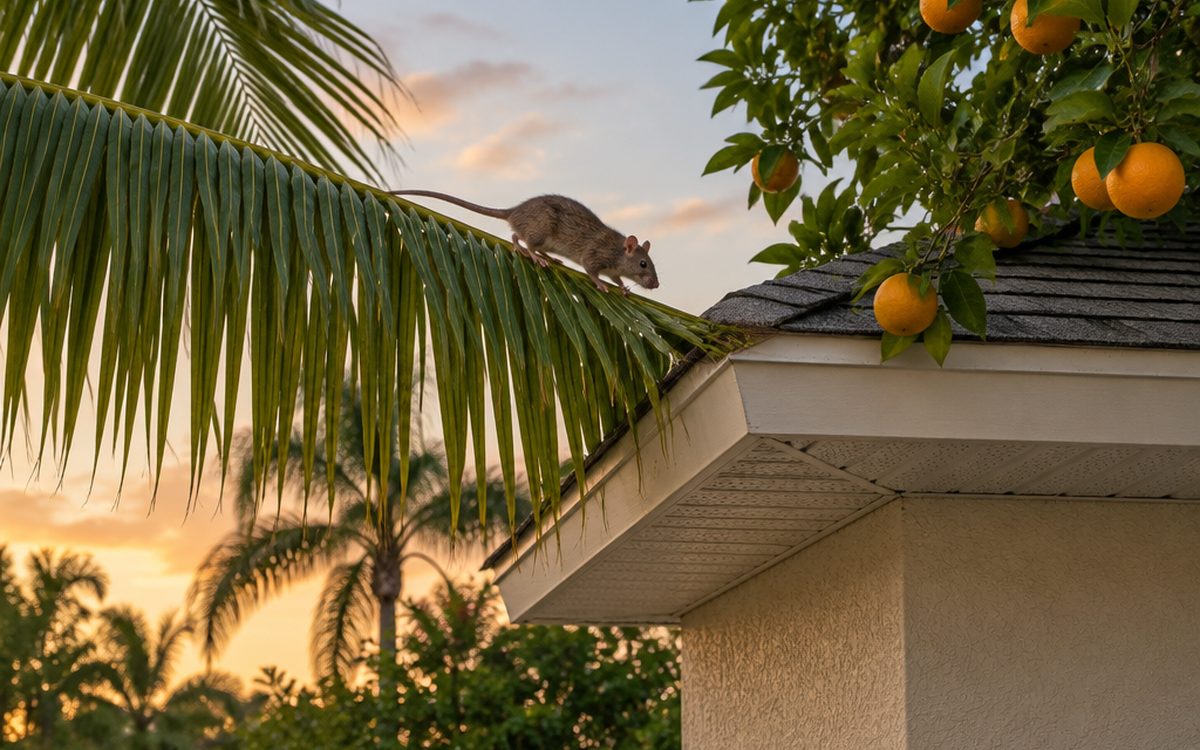
Roof rat vs Norway rat vs mouse comes down to four things: size, tail, droppings and where you find them. A roof rat is slim, has a tail longer than its body and lives up high. A Norway rat is heavy, has a shorter tail and lives low, often in a burrow. A house mouse is small, and so are its droppings. In a Brevard County home, the one in the attic is usually a roof rat.
TL;DR
- Roof rat: sleek, 5 to 10 ounces, tail longer than the body, big ears. Lives in attics, trees and palms.
- Norway rat: stocky, 7 to 18 ounces, shorter tail, small ears. Lives low and digs burrows.
- House mouse: small and light, with droppings much smaller than a rat's. Lives near food, in tight spaces.
- Rat droppings run about 1/2 to 3/4 inch. Roof rat droppings have pointed ends, Norway rat droppings have rounded ends.
- The species tells you where they get in, so it tells you what to seal.
How to tell a roof rat from a Norway rat
The University of California IPM program gives a simple check: look at the tail. A roof rat's tail is longer than its head and body together. Fold it over the back and it reaches at least to the nose. A Norway rat's tail is shorter. It only reaches about the middle of the head.
Then look at the face and the ears. A roof rat has a pointed nose and big ears that reach the eyes when folded forward. A Norway rat has a blunt nose and small ears that do not reach the eyes.
Weight helps too. UC IPM puts an adult roof rat at about 5 to 10 ounces and a Norway rat at about 7 to 18 ounces.
Around here people also call the roof rat the citrus rat or the palm rat. Those names tell you where it likes to live.
Is it a mouse or a young rat?
A young rat is small, and it can pass for a mouse at first glance.
UC IPM says the giveaway is the head and the feet. A young rat has a big head and big back feet for its body. An adult mouse has a small head and small feet. Chew marks help as well. A rat leaves tooth marks about 1/6 inch wide. A mouse leaves fine, scratchy marks about half that.
Droppings are the easiest clue, because you will see those long before you see the animal. NC State Extension puts rat droppings at about 1/2 to 3/4 inch, with pointed ends on a roof rat and rounded ends on a Norway rat. Mouse droppings are much smaller. Big droppings with pointed ends in the attic mean a roof rat.
Roof rat vs Norway rat vs mouse: where each one lives
- Up high. Attic, soffits, the top of the garage wall, palm trees, citrus trees. That is roof rat country. UC IPM says roof rats nest above the ground and climb very well. They travel on limbs, fence tops and power lines.
- Down low. Burrows along the slab, under a shed, under a woodpile or in a garden bed. That points to a Norway rat. When both live in one building, UC IPM says Norway rats stay on the ground floor and roof rats take the upper floors.
- Close to food, in tight spaces. Behind the stove, in a kitchen drawer, inside a wall near the pantry. That is classic mouse behavior. Mice nest near what they eat.
Both rats can squeeze under a door with a gap of only 1/2 inch. UC IPM says a mouse can get through an opening as small as 1/4 inch. We cover gap sizes in more detail in how small a hole a rat can get through.
What we see in Brevard
In a Brevard County home, the rodent in the attic is usually a roof rat. It lives up high and crosses a neighborhood on limbs and fence tops, so it gets in at the roofline, not at the ground. Technicians report that roof rats like to nest against AC ducts and in soffit corners. That is why we look there first.
So the fix is up high too. Trim palm fronds and tree limbs back from the roof. Pick up fallen citrus. Check the soffits and the gable vents. Our post on noises in the attic at night covers what the sounds usually mean.
Norway rats and mice do show up, mostly in garages and kitchens. They usually get in low, at a door seal or a pipe gap.
What to do now
- Look for droppings first. Measure one against a coin or a ruler. Do not touch it.
- Note where you found it: attic and roofline, ground level, or the kitchen.
- Walk the outside. Look for limbs touching the roof, palm fronds on the shingles, burrows along the slab and gaps at the garage door.
- Do not sweep or vacuum droppings. The CDC says that puts germs in the air. Wet them first and wear gloves.
When to call somebody
If you find droppings in more than one spot, hear noise for more than a week, or see a chewed wire, get it looked at. The species changes which openings matter, and sealing the wrong ones does not help. Our rat inspection is free, and rodent work is quoted after the inspection, separate from our pest plans. There is no contract.
Sources
- UC IPM: Rats
- UC IPM: House Mouse
- NC State Extension: Surveillance and Management of Common Structure-Invading Rats
- CDC: How to Clean Up After Rodents
Frequently Asked Questions
How do I tell a roof rat from a Norway rat?
Look at the tail. A roof rat's tail is longer than its head and body together. A Norway rat's tail is shorter. A roof rat also has a pointed nose and big ears that reach the eyes when folded forward. A Norway rat has a blunt nose and small ears.
How much does a roof rat weigh compared to a Norway rat?
UC IPM puts an adult roof rat at about 5 to 10 ounces and a Norway rat at about 7 to 18 ounces.
How can I tell a mouse from a young rat?
A young rat has a big head and big back feet for its body. An adult mouse has a small head and small feet. Droppings help too: rat droppings run about 1/2 to 3/4 inch, and mouse droppings are much smaller.
Which rodent is usually in a Brevard County attic?
Usually a roof rat. It lives up high, travels on limbs and fence tops, and gets in at the roofline. Norway rats and mice show up more in garages and kitchens and usually get in low.
Should I sweep up rodent droppings?
No. The CDC says sweeping or vacuuming droppings puts germs in the air. Wet them first and wear gloves.
Dealing with this at your place?
Gator Pest Control has served Brevard County since 1994. Free estimates, no contracts.
Get a Free Estimate Call (321) 253-1188