
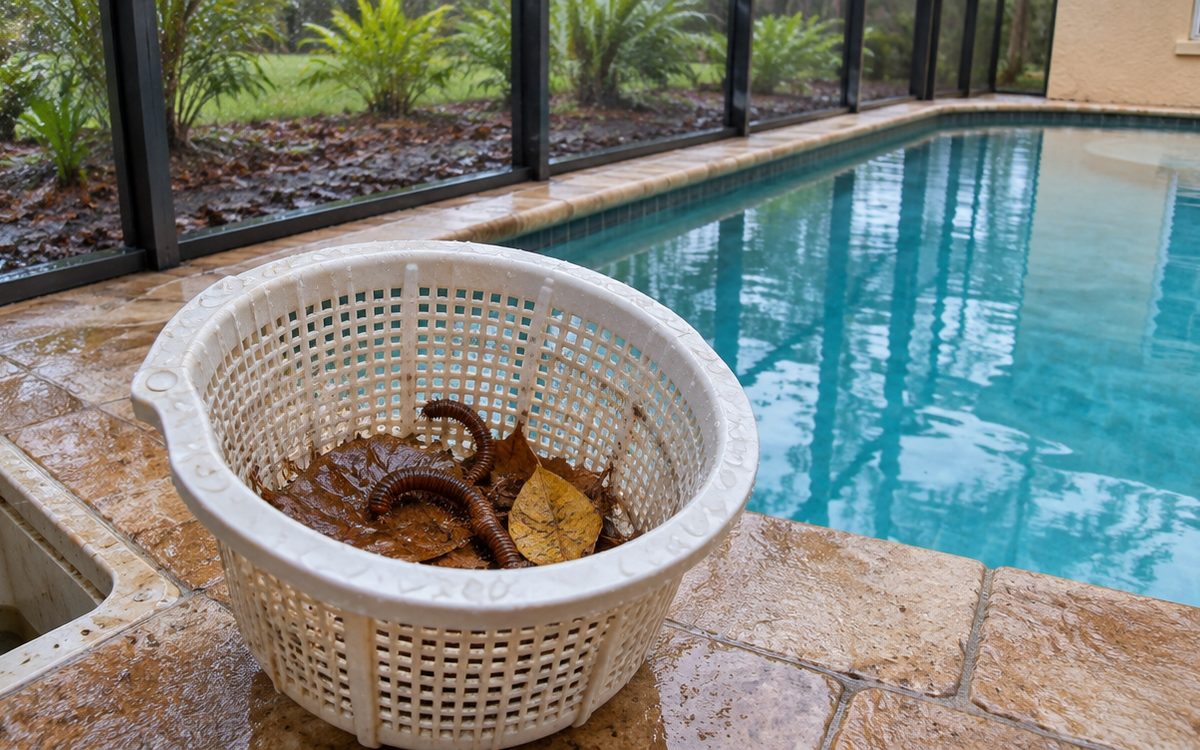
If you find millipedes in pool water, the soil around the pool got too wet. Rain or heavy irrigation soaks the mulch beds, millipedes climb out looking for higher ground, and the pool deck is the closest flat, open spot. They walk across it at night, fall in the water and drown. In Brevard County this is a fall and early summer story, and the fix is in the planter beds, not the pool.
TL;DR
- Millipedes live in damp mulch and leaf litter. Soaked soil pushes them out in waves.
- They do not breed in the pool. They wander in, fall in and drown.
- The real nuisance is the filter. Enough of them can clog the skimmer and pump baskets.
- Do not spray pesticide around the pool. Skim them out and fix the beds instead.
- Most waves end when the ground dries out.
Why do millipedes end up in the pool?
Millipedes need damp ground to live, but they cannot handle soil that is full of water. Ohio State University Extension explains that saturated soil pushes them up to the surface and off to higher ground. Very dry weather can move them too, as they go looking for damp.
A pool deck sits right next to the beds where they live. NC State Extension notes that millipedes are drawn to the moist concrete apron around a pool, then fall in. Once they are in the water they cannot get out. They drown and float, or sink to the bottom and get pulled toward the drain.
They are not in the pool on purpose, and they are not living there. Every millipede in the water walked in from the yard that night or the night before.
Are millipedes in pool water a problem?
For swimmers, not really. Millipedes do not bite or sting. Some kinds give off a fluid that can irritate skin, so scoop them with the net, not your hand. We covered that in more detail in whether millipedes are dangerous.
For the pool, the problem is the equipment. NC State Extension says millipedes can clog a pool's drain and filtering system. A few dozen a night, every night of a wet week, adds up in the skimmer basket and the pump basket. A full basket cuts the flow, and the pump works harder than it should.
The other thing to know: NC State also says there are no pesticides suitable for applying around a pool. Spraying the deck puts product where people walk barefoot and where it can wash into the water. It is the wrong tool for this job.
When are millipedes in the pool worst in Brevard?
Ohio State says millipede invasions run mostly in late summer and fall, with pool trouble as early as late June. That matches Florida, where they move most with the spring and fall weather changes and after any long rainy stretch.
In Brevard, the pattern to watch is a few days of rain on top of sprinklers that still run on a summer schedule. The beds next to the pool cage never dry out, and the millipedes start moving.
What we see in Brevard
A lot of Brevard pools sit inside a screened cage with a planter bed or a mulch strip right outside the screen. Millipedes crawl in at the bottom of the screen and gather on the deck, the same thing we see on lanais after fall rain. We wrote about the bigger picture in why there are so many millipedes in your house.
The bottom of the cage is where to look. A torn screen panel near the ground, a gap under the kick plate, or mulch piled up against the frame gives them an easy way in.
What to do now
- Skim every morning and empty the baskets. Net the floaters, then check the skimmer basket and the pump basket so the filter keeps its flow.
- Cut back the water. Run sprinklers in the early morning, not at night, and point heads away from the cage and the deck.
- Pull the mulch back from the cage. Ohio State suggests a strip about three feet wide around the foundation, raked clear of leaf litter and plant debris, where that is practical. Do the same along the bottom of the pool cage.
- Fix the bottom of the screen. Patch torn lower panels and close gaps under the kick plate.
- Wait out the wet week. Ohio State notes that total control during a migration is hard. Most waves stop when the ground dries.
When to call somebody
If you have fixed the beds and the water and you are still netting dozens a day for a couple of weeks, or roaches and ants are coming in the same way, it is worth a look. A good visit starts with where the water and the gaps are, not with spraying the deck. Our general pest control covers the patio, lanai and perimeter zones, and every plan is on the pricing page.
Sources
Frequently Asked Questions
Why are there millipedes in my pool?
Rain or heavy irrigation soaks the mulch beds, so millipedes climb out looking for higher ground. The pool deck is the closest open spot. They walk across it at night, fall in the water and drown.
Do millipedes live or breed in the pool?
No. They wander in from the yard, fall in and drown. Every millipede in the water walked in that night or the night before.
Can millipedes clog a pool filter?
Yes. NC State Extension says millipedes can clog a pool's drain and filtering system. Skim every morning and empty the skimmer basket and the pump basket during a wet week.
Should I spray pesticide around my pool for millipedes?
No. NC State Extension says there are no pesticides suitable for applying around a pool. Skim them out, cut back the sprinklers, pull the mulch back from the cage and fix the bottom of the screen.
When do millipedes in the pool stop?
Most waves end when the ground dries out. Ohio State Extension notes that total control during a migration is hard, so fixing the wet beds next to the pool does more than anything else.
Dealing with this at your place?
Gator Pest Control has served Brevard County since 1994. Free estimates, no contracts.
Get a Free Estimate Call (321) 253-1188