
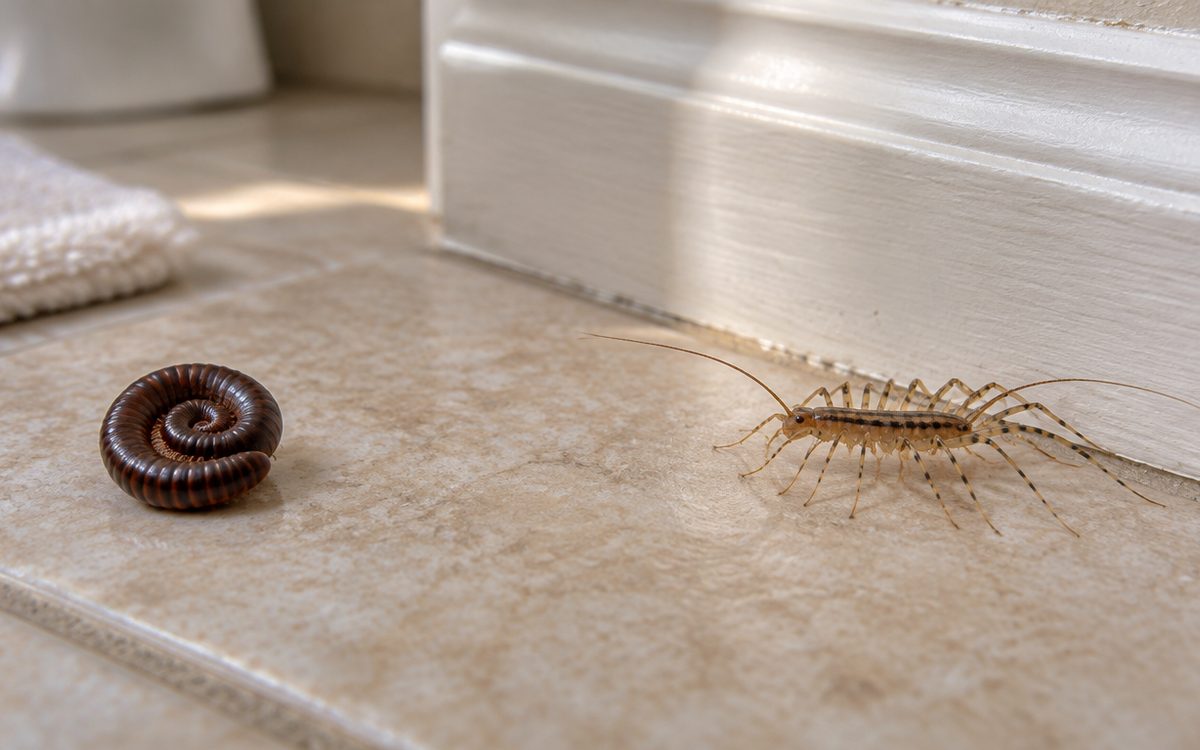
Millipede vs centipede in the house comes down to shape and speed. A millipede is round, slow and curls into a coil, and it walked in from wet soil outside. A centipede is flat, fast and runs for cover, and it is inside because it found bugs to eat. In Brevard County homes the millipede is the more common sight after fall rain, but the centipede is the one that can bite and the one that can live indoors.
TL;DR
- Millipede: round body, two pairs of legs on each segment, slow, curls up. No bite.
- Centipede: flat body, one pair of legs on each segment, very fast, never curls up. Can bite if you grab it.
- Millipedes inside mean the yard is too wet. They die indoors within a short time.
- A centipede inside means there is damp and there are other bugs for it to hunt.
- Neither one damages the house, and sprays rarely help with either.
Millipede vs centipede in the house: the five second check
Look at how it moves first. UC IPM, the University of California pest program, puts the difference plainly: centipedes move fast and millipedes do not. If it shot under the baseboard, it was a centipede. If it plodded along or curled into a coil when you nudged it with a broom, it was a millipede. UC IPM notes that centipedes never coil.
Then look at the body and the legs. A millipede is round like a worm, brown to black, with two pairs of short legs on most segments, so the legs look like a fringe underneath. A centipede is flat, with one pair of legs per segment that stick out to the sides, and the last pair trails out behind it. The house centipede is the extreme version: Iowa State Extension describes a body about 1.5 inches long with 15 pairs of very long legs, each nearly as long as the body.
Which one bites?
The centipede. UF/IFAS Extension in Sarasota County points out that centipedes have biting mouthparts and millipedes do not. UC IPM says a centipede bite can cause swelling, discoloration and numbness around the spot. Most bites happen when someone picks one up or traps it against the skin. If a bite swells a lot or you have a history of bad reactions to stings, call your doctor.
A millipede cannot bite, but it is not something to handle either. Some kinds give off a fluid that can irritate skin and burn the eyes. We covered that, and what to do if the dog mouths one, in our post on whether millipedes are dangerous. Use a broom or a vacuum on both.
What each one tells you about your house
A millipede in the house is a yard problem. Millipedes live in damp mulch, leaf litter and topsoil. When rain or sprinklers soak the ground, they climb out and walk to the nearest dry spot, which is often your slab. UC IPM notes that strays usually die quickly indoors and that these invasions typically end within a few days. Our post on why there are so many millipedes in the house walks through it.
A centipede in the house is an indoor problem, a small one. Centipedes hunt. UC IPM says house centipedes catch flies, cockroaches and other small household pests, and Iowa State lists insects, larvae and spiders. They stay in damp spots like bathrooms, closets and storage areas. So one centipede now and then is not a big deal. Seeing them often means two things are true: the spot stays damp, and something is living there for it to eat. I would take that as a reason to look for roaches, silverfish or spiders, not to chase the centipede.
What we see in Brevard
A lot of Brevard homes are block and slab, with a mulch bed or rock bed right against the wall and sprinkler heads pointed at it. That wet strip is the millipede bed. The other common spots are the lanai and the screened pool cage, where millipedes crawl in under the bottom of the screen, and the garage, where the rubber seal at the bottom of the door is often worn.
Centipedes follow the damp indoors instead: a guest bath nobody runs, a laundry room, a closet on an outside wall, boxes on a garage floor.
What to do now
- Name it first. Round and slow is a millipede. Flat and fast is a centipede.
- Sweep or vacuum it up. Do not pick up either one by hand.
- For millipedes, dry out the outside. Run sprinklers in the early morning, keep heads off the wall, and pull mulch back a few inches from the slab.
- For centipedes, dry out the inside. Run the bath fan, fix drips under sinks, and get boxes off the garage floor.
- Seal the door gaps. A good door sweep and garage door seal stop a lot of both.
When to call somebody
UC IPM says pesticides are seldom justified for either one, and Iowa State notes that sprays for house centipedes have limited effect. So the fixes above come first. If you still see centipedes every week, or you are finding roaches or other bugs in the same damp rooms, that is the real issue, and it is worth a look. Our general pest control covers crawling pests at the foundation, garage, lanai and indoor pathways, and every plan is on the pricing page.
Sources
- UC IPM Pest Notes: Centipedes and Millipedes, Publication 7472
- Iowa State University Extension, House Centipedes: Beneficial Predators or Nuisance?
- UF/IFAS Extension Sarasota County, The Spooky Bug Brigade: Millipedes
Frequently Asked Questions
How do I tell a millipede from a centipede in the house?
Look at how it moves and its shape. A millipede is round, slow and curls into a coil, with two pairs of legs on each segment. A centipede is flat and very fast, with one pair of legs per segment, and it never curls up.
Which one bites, a millipede or a centipede?
The centipede. Centipedes have biting mouthparts and millipedes do not. UC IPM says a centipede bite can cause swelling, discoloration and numbness around the spot. Most bites happen when someone picks one up or traps it against the skin.
What does a millipede in the house mean?
It means the yard is too wet. Millipedes live in damp mulch, leaf litter and topsoil, and rain or sprinklers push them onto the slab. Strays usually die quickly indoors, and these invasions typically end within a few days.
What does a centipede in the house mean?
Centipedes hunt flies, cockroaches, spiders and other small pests, and they stay in damp spots like bathrooms and closets. Seeing them often means the spot stays damp and something is living there for them to eat.
Should I spray for millipedes or centipedes?
Usually not. UC IPM says pesticides are seldom justified for either one, and Iowa State notes that sprays for house centipedes have limited effect. Dry out the damp spots, sweep or vacuum them up and seal the door gaps first.
Dealing with this at your place?
Gator Pest Control has served Brevard County since 1994. Free estimates, no contracts.
Get a Free Estimate Call (321) 253-1188