
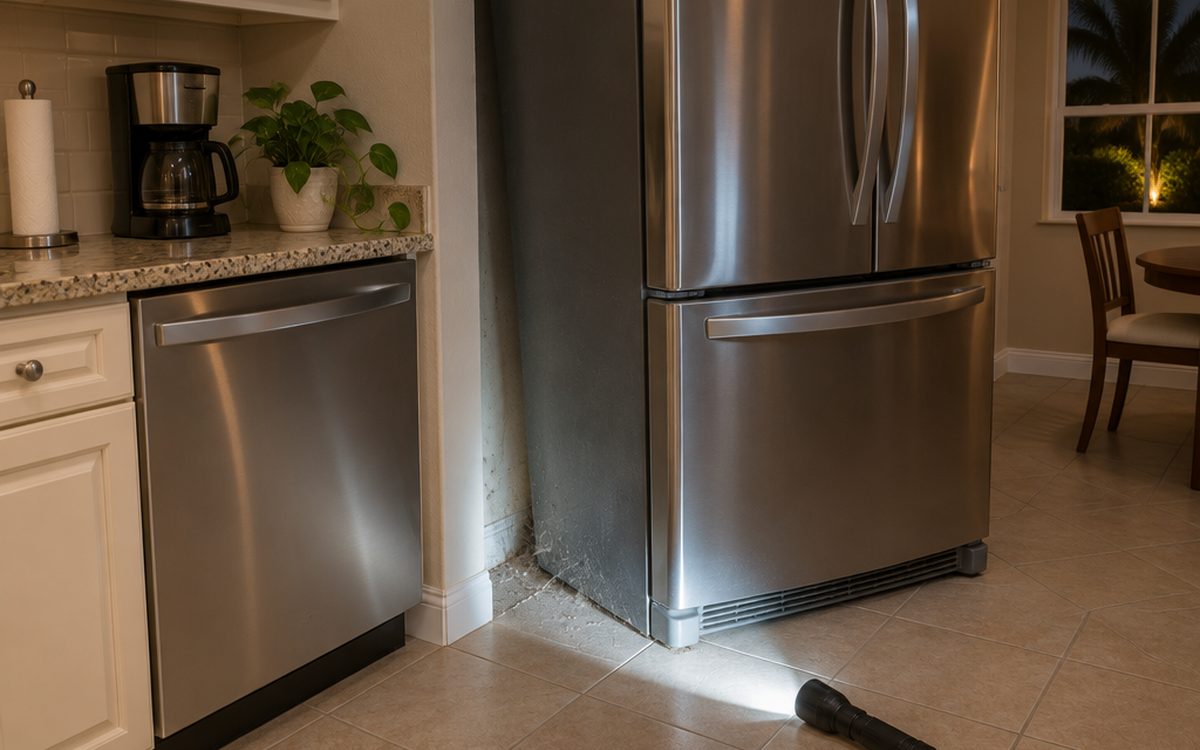
German roaches in appliances are common because a dishwasher, microwave, coffee maker or fridge gives them three things at once: warmth, moisture and crumbs, in a tight dark space. In Brevard County kitchens, the area around the stove and the refrigerator is usually where the most roaches live. The fix is a careful look around and under the appliance, then bait and follow up visits, not a can of spray pointed inside it.
TL;DR
- German roaches like warm, damp, tight spaces. Appliances have all three.
- The worst spots are usually behind the fridge, beside the stove and under the dishwasher.
- Do not spray inside an appliance or into its electrical parts. Do not set off a bomb.
- Sticky traps show you where they are. Bait and follow ups clear them out.
- Used appliances and cardboard boxes are a common way they get in.
Why do German roaches live in appliances?
German roaches spend most of their life hidden in tight cracks. UC IPM says an adult can squeeze into a crack about 1/16 of an inch wide, and the young ones fit into smaller gaps still. They like it warm, around 70 to 75 degrees, and humid, close to food and water.
Now think about a kitchen. The motor under a fridge runs warm all day. A dishwasher has a damp floor and food bits in the seal. A microwave and a coffee maker sit on the counter with crumbs and spills around them. UC IPM notes that egg cases may even be found glued in refrigerator and appliance motors.
Rutgers says the areas around the stove and the refrigerator usually have the most roaches in the house. That is not because the appliance is dirty. It is because it is warm, and nobody pulls it out to look behind it.
Where to check for German roaches in appliances
Use a flashlight at night, when they are active. Look for live roaches, small black specks like pepper, shed skins and tan egg cases.
- Fridge. The back, the floor under the front grille, and the gap beside the cabinet. Rutgers lists the back of the refrigerator as a common hiding spot.
- Stove. The gap on each side, the drawer under the oven and the floor behind it.
- Dishwasher. The kick plate at the bottom, the door seal and the cabinet under the sink next to it.
- Microwave, toaster and coffee maker. Underneath, around the base and behind the unit on the counter.
Sticky traps tell you more than your eyes do. Put them on the floor by the fridge and the stove, inside the sink cabinet and behind large appliances, then check them every few days. The trap with the most roaches points to the nest.
Why spraying inside an appliance is a mistake
It is tempting to grab a can and spray into the microwave or under the dishwasher. Do not. Spray inside an appliance can end up on food surfaces, and electrical parts are no place for a wet spray. Rutgers also notes that sprays work poorly on German roaches because of resistance, and that they can push roaches into the units next door through pipes and shared walls.
Roach bombs are worse here. UC IPM says foggers rarely reach the places roaches hide. Rutgers says total release foggers do not work on cockroaches, and that using too many can create a fire hazard in homes with gas appliances. A Pacific Northwest Extension handbook adds that foggers can scatter roaches into the units next door.
What we see in Brevard
The small tan roach in a Brevard kitchen very often came in with something: groceries, cardboard boxes or a used appliance. A secondhand fridge, a donated microwave or a coffee maker from a yard sale can carry a few roaches and an egg case home with it. Extension handbooks list used appliances as one of the ways German roaches get into a building.
Ron's other point is that German roaches build resistance, so a real job needs products rotated in a set order, timed to their life cycle. One treatment knocks down what is out in the open. The babies inside a warm motor housing come out a couple of weeks later. That is why we talk about a plan over several visits, and why we covered how long it takes to get rid of German roaches in its own post.
What to do now
- Look before you treat. Pull the fridge and the stove out if you can do it safely, and check behind and under them with a flashlight.
- Clean the warm spots. Vacuum behind and under the fridge and stove, wipe the dishwasher seal, and empty the crumb tray in the toaster.
- Fix the water. A dishwasher or ice maker that drips under the cabinet keeps roaches alive. Get the leak fixed.
- Set sticky traps. Place them by each appliance and write down the count every few days.
- Check anything secondhand. Look a used appliance over outside, in daylight, before it comes into the kitchen.
When to call somebody
If the traps keep catching roaches after a couple of weeks, or you see them in the daytime, the nest is bigger than what you can see. A good visit starts with an inspection of every appliance, then baits placed where they hide, not sprayed into the machine. Roaches are part of our general pest control service, and our roach guide explains how to tell a German roach from the bigger palmetto bug.
Sources
- UC IPM, Cockroaches Pest Notes
- Rutgers Cooperative Extension, German Cockroach FS1322
- Pacific Northwest Insect Management Handbook, Cockroach
Frequently Asked Questions
Why do German roaches live in appliances?
Appliances give them warmth, moisture and crumbs in a tight dark space. UC IPM says an adult can fit into a crack about 1/16 of an inch wide, and egg cases may be found glued in refrigerator and appliance motors.
Where in the kitchen do German roaches hide most?
Rutgers Extension says the areas around the stove and the refrigerator usually have the most roaches. Check the back of the fridge, the gaps beside the stove and the dishwasher kick plate.
Should I spray inside my microwave or dishwasher for roaches?
No. Spray inside an appliance can end up on food surfaces, and electrical parts are no place for a wet spray. Sprays also work poorly on German roaches and can push them into the next unit.
Do roach bombs work on roaches in appliances?
No. UC IPM says foggers rarely reach the places roaches hide, and Rutgers says total release foggers do not work on cockroaches and can be a fire hazard in homes with gas appliances.
Can a used appliance bring German roaches home?
Yes. Extension handbooks list used appliances and cardboard boxes as ways German roaches get into a building. Look a secondhand appliance over outside, in daylight, before it comes into the kitchen.
Dealing with this at your place?
Gator Pest Control has served Brevard County since 1994. Free estimates, no contracts.
Get a Free Estimate Call (321) 253-1188