
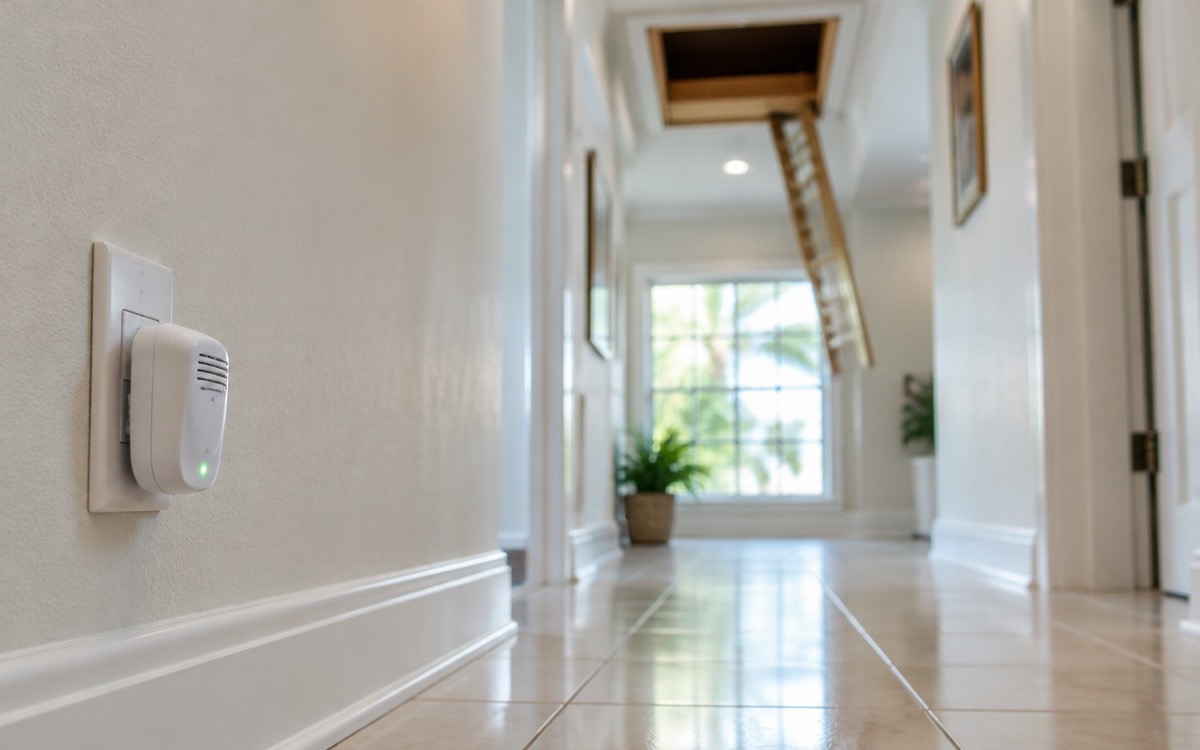
Not well enough to count on. Ultrasonic pest repellers have never had good evidence behind them, and the Federal Trade Commission has warned sellers about their claims more than once. In a Brevard County home with roof rats in the attic or roaches in the kitchen, a plug in box will not fix the problem.
TL;DR
- The FTC sent warning letters to more than 60 makers and sellers of these devices in 2001.
- Rats and mice may react at first, then get used to the sound and come back.
- The FTC has said ultrasound does not control insects. That covers roaches and ants.
- Sound stops at walls, furniture and insulation, so most of a house is never covered.
- The fix that lasts is plain: close the way in, take away the food, and trap what is inside.
What these plug in boxes claim to do
The box plugs into a wall outlet. It makes a high pitched sound, above what a person can hear. The idea is that the sound is so unpleasant that rats, mice, roaches, ants and spiders leave and do not come back.
They are cheap, they need no chemicals, and you never touch a trap. That is why people buy them. I understand it. Nobody wants to deal with a rat.
The trouble is the word "repel". To repel a pest, the sound has to bother it, keep bothering it, and reach every place it lives. The evidence says it does not do any of those well.
Do ultrasonic pest repellers work on rats and mice?
Not for long. In 2001 the FTC sent warning letters to more than 60 manufacturers and retailers. The letters told them they need real scientific evidence to claim a device gets rid of rodents or repels insects. Before that, from 1985 to 1997, the FTC brought cases against six companies over the same kind of claims.
In those cases the FTC argued that any reaction from a rodent is temporary at best. Rats and mice get used to the sound. Then they go back to where they nest and feed, even with the device still running.
Think about where a rat lives. A roof rat sits in the attic, under blown in insulation, behind a truss. A sound from a box in the hallway outlet does not get through a ceiling and a foot of insulation. Sound does not bend around corners well, and soft things soak it up. So even if the sound did bother a rat, the rat has a quiet room to go to.
Do they work on roaches, ants or mosquitoes?
No. The FTC complaints said ultrasound devices do not control insects. A Cochrane review looked at ten field studies of electronic mosquito repellers. All ten found no difference in how many mosquitoes landed on people with the device on or off.
That matters here. A German roach colony lives inside the cabinet walls and behind the fridge. Ghost ants nest in the wall void and come out along the counter. A sound box does nothing to the nest, and the nest is the whole problem. We wrote more on that in why you keep seeing ants in your home.
One more thing. If you keep a hamster, a guinea pig or another small pet rodent, it can hear in the same range these boxes use. The box will not move a wild rat out of your attic, but it may stress the one in the cage.
What we see in Brevard
On the Space Coast the rodent call is almost always roof rats. They climb. They come in over the top of the house, along a palm frond on the roof or through a gap where the soffit meets the fascia. On a block home, the gaps around the AC line and plumbing are the other easy door.
A sound box does nothing about any of that. The gap stays open. The rat that left for a night comes back through the same hole, and so do its friends. That is why we start with the way in, not the noise. Our post on how small a hole a rat can get through shows how little room they need.
What to do now
- Unplug the box. If you still have the receipt, check the return window.
- Walk the outside of the house. Look at the roofline, soffit corners, gable vents, and where pipes and the AC line go through the wall.
- Trim the ramps. Cut back palm fronds and limbs so nothing touches the roof.
- Take away the food. Pick up pet food at night, put a lid on the trash, and keep birdseed in a metal can.
- Trap what is already inside. Snap traps along the walls, where rats run. Not poison first, so nothing dies inside the wall.
When to call somebody
If you hear running in the attic at night, see droppings, or find chewed wire, the rats are already living there. That takes sealing every entry point and trapping out what is inside. Our rodent control starts with a free inspection, and if roaches or ants are the problem, general pest control covers those. Either way, save the money you were going to spend on another sound box.
Sources
- Iowa State University Extension: the FTC warning on ultrasonic pest control devices, May 2001
- Cochrane Review: Electronic mosquito repellents for preventing mosquito bites
Frequently Asked Questions
Do ultrasonic pest repellers work?
Not well enough to count on. They have never had good evidence behind them, and the FTC has warned sellers about their claims more than once.
Do ultrasonic repellers keep rats and mice away?
Not for long. The FTC argued that any reaction from a rodent is temporary at best, because rats and mice get used to the sound and go back to where they nest and feed.
Do ultrasonic repellers work on roaches and ants?
No. The FTC complaints said ultrasound devices do not control insects, and the nest inside the wall is the real problem.
Why can a sound box not reach rats in the attic?
Sound does not get through a ceiling and a foot of insulation, and it does not bend around corners well. The rat always has a quiet place to go.
What works better than an ultrasonic repeller?
Close the way in, take away the food, and trap what is already inside. Trim palm fronds and limbs so nothing touches the roof.
Dealing with this at your place?
Gator Pest Control has served Brevard County since 1994. Free estimates, no contracts.
Get a Free Estimate Call (321) 253-1188